George Yard
George Yard is a small courtyard off Lombard Street and Gracechurch Street in the historic core of the City of London. Once the yard of a Tudor coaching inn, it later became a narrow service alley threaded between merchants’ houses, warehouses and taverns.
In the 20th century most of the older buildings were replaced by larger office blocks, and the space was opened out into a more generous paved and cobbled yard. Today it is framed by modern offices yet still feels tucked away, a pocket of semi‑hidden space amid the City’s main streets. Seating, planting and contemporary ventilation structures give it a slightly sculptural, urban‑courtyard character. It serves mainly as a cut‑through and service space, but also as a brief pause point in the dense financial district.
Just around the corner from St Edmund and Martyr Church
-
Yard of a Tudor coaching innGeorge Yard takes its name from the George Inn, a large Tudor coaching inn that once occupied this site and served travellers arriving and departing along the main routes into the City. After the Great Fire the inn’s site was rebuilt as a yard lined with “very good houses and warehouses”, already known as George Yard by the early 18th century.
-
Historic link between key City streetsIn the 18th and 19th centuries, George Yard provided a narrow but important pedestrian link from Lombard Street through to St Michael’s Alley and Cornhill, threading behind shopfronts and banking houses in a maze of courts and alleys. Contemporary directories list numerous merchants and trades here, reflecting how intensely the area was built up and used.
-
Surviving alley cluster around a Wren churchGeorge Yard sits in the middle of a small surviving cluster of historic alleys around the Wren church of St Edmund, King and Martyr, including passages such as Lombard Court and Bengal Court. Together they preserve the tight, back‑lane grain of the pre‑modern City in contrast to the broader post‑war streets.
-
20 Gracechurch Street and Barclays BankMuch of the older yard was swept away in the late 20th century to make room for 20 Gracechurch Street, a post‑modern office block originally built for Barclays Bank that took over the whole corner plot. The development merged many smaller buildings into one large complex, reshaping George Yard into the more open, two‑part courtyard you see today
Jamaica Wine House
Jamaica Wine House is a Grade II‑listed Victorian pub tucked away in St Michael’s Alley off Cornhill, in the heart of the City of London’s financial district.
Known locally as “The Jampot”, it stands on the site of London’s first coffee house, opened in 1652 by Pasqua Rosée and visited by diarist Samuel Pepys.
The present red‑brick and sandstone building dates from the late 19th century and retains a traditional interior of dark wood panelling, cosy bars and period details. Set within a labyrinth of medieval courts and alleys, it offers an atmospheric retreat from the surrounding office blocks and busy streets. Today it operates as a popular pub and wine bar, frequented by City workers, tourists and history enthusiasts
In between the Georges Yard and St Michaels Alley.
-
First coffee house in LondonJamaica Wine House stands on the site of London’s first coffee house, opened in 1652 by Pasqua Rosée in St Michael’s Alley, then known as “Pasqua Rosee’s Head” or “The Turk’s Head”. A plaque outside records this origin and commemorates the alley as the birthplace of London’s coffeehouse culture.
-
Pasqua Rosée and Ottoman coffeePasqua Rosée was a Greek servant of Levant Company merchant Daniel Edwards, who imported coffee from the Ottoman Empire and helped Rosée set up the business. Contemporary accounts suggest the tiny shed‑like premises quickly became popular, reportedly selling hundreds of cups of coffee a day to curious Londoners.
-
From “Pasqua Rosee’s Head” to Jamaica Coffee HouseThe original coffee shed was destroyed in the Great Fire of London in 1666 and rebuilt in the 1670s as the Jamaica Coffee House. The new name reflected its client base of West India merchants and planters and its focus on business tied to Jamaica and the wider Atlantic trade
-
Deep ties to the slave and sugar tradesIn the 18th century the Jamaica Coffee House served as an informal meeting place for slave‑traders, plantation owners, merchants and insurers dealing in sugar, rum and enslaved people from the Caribbean. Notices about enslaved people and business conducted there appear in period newspapers and pamphlets, making the address a recognised contact point for West India trade
-
Birthplace of “coffeehouse capitalism”Like other early London coffeehouses, this site functioned as a subscription meeting room where businessmen, ship captains and brokers exchanged news, prices and gossip, helping to shape financial markets and political opinion. Historians often cite such coffeehouses as precursors to modern clubs, exchanges and the financial information networks that underpin the City today.
-
Victorian rebuilding and present pubThe current red‑brick, late‑19th‑century building is a Grade II‑listed pub interior with wood‑panelled bars and a cellar restaurant, restored and re‑opened by Shepherd Neame in 2009. Despite its modern role as a popular City pub, the Jamaica Wine House still carries visible reminders of its coffeehouse and colonial past in plaques, signage and its tightly enclosed alley setting.
St Edmund Martyr on Lombard Street
A medieval banking hub on Lombard Street, once lined with goldsmiths and marked by golden grasshopper signs of the Mercers’ Company, with links to the early world of Lloyd’s and marine insurance.
St Michael’s Church, Cornhill
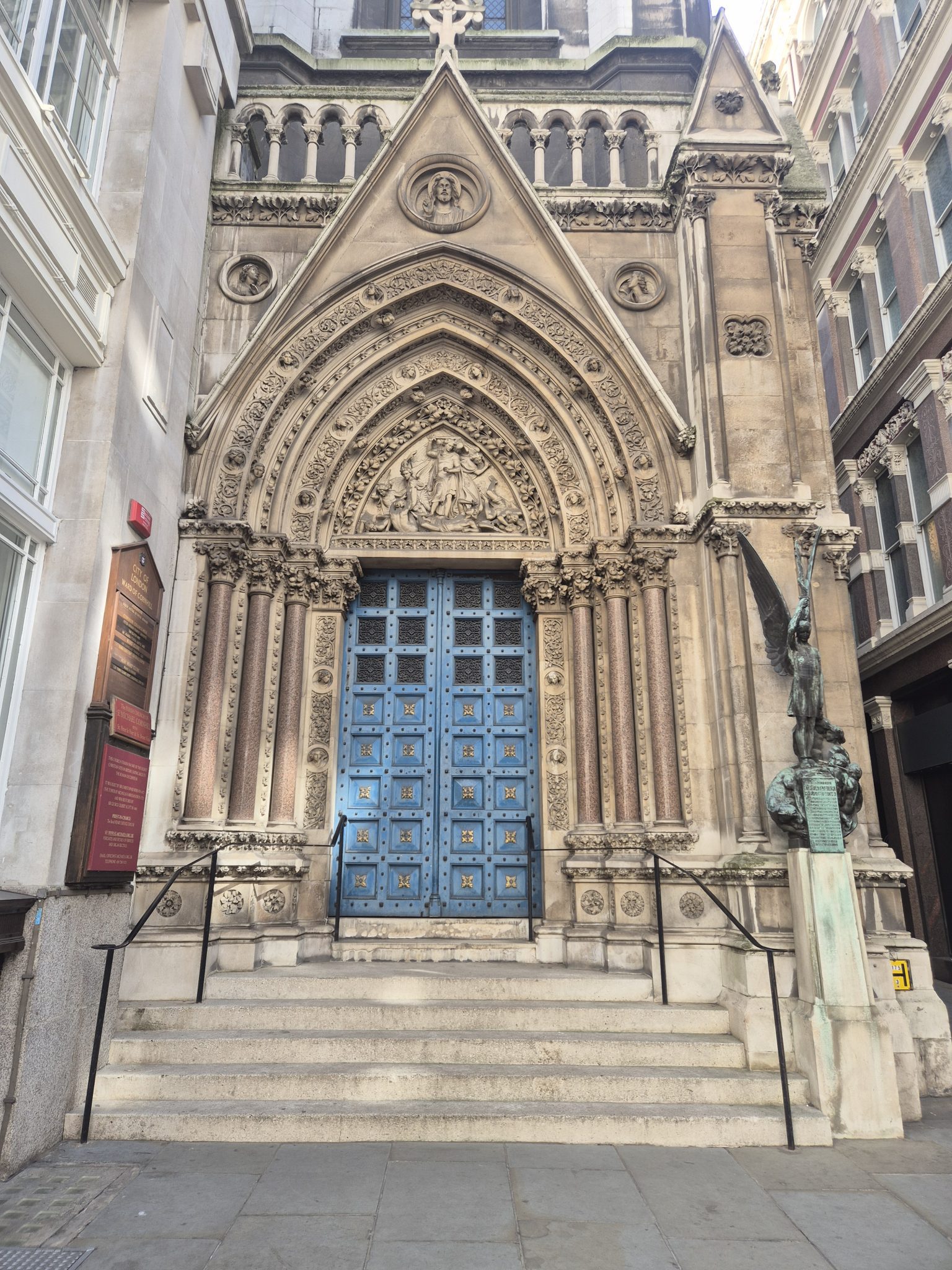
St Michael’s Church, Cornhill is a historic City of London church just off Cornhill, standing above the remains of the Roman basilica and forum of Londinium. Tradition links this spot to a church founded by the semi‑legendary King Lucius around 179 AD, often cited as the oldest recorded site of Christian worship in London.
The medieval church here was destroyed in the Great Fire of 1666 and rebuilt soon after, traditionally associated with Christopher Wren’s office, with its tower’s upper stages later completed by Nicholas Hawksmoor. In the 19th century Sir George Gilbert Scott transformed the interior in rich High Victorian Gothic style, adding a dramatic porch facing Cornhill with a tympanum of St Michael disputing with Satan. Today the church’s tower, spire and ornate porch form a striking landmark among offices and alleys, and it remains an active place of worship and music at the heart of the banking district.
-
Built over Roman Londinium’s basilicaSt Michael’s stands directly above the northern end of the Roman basilica and forum, the main civic and administrative complex of Londinium built in the first and second centuries AD. Some of the church’s foundations still sit on Roman walls, and its slightly irregular plan reflects the reuse of earlier foundations.
-
Claim to London’s earliest Christian siteChurch tradition associates this spot (or very nearby) with a church founded by the legendary British King Lucius around 179 AD, often described as the oldest recorded site of Christian worship in London. Documentary evidence shows a church of St Michael here by 1055, when a priest named Alnothus granted it to the abbot of Evesham, confirming its pre‑Conquest origin.
-
Wren rebuilding and Hawksmoor towerThe medieval church, apart from its tower, was destroyed in the Great Fire of 1666 and rebuilt between 1669 and 1672, traditionally under Sir Christopher Wren. The old tower was later demolished as unsafe, and a new 130‑foot “Gothick” tower, inspired by Magdalen College, Oxford and completed by Nicholas Hawksmoor in 1722, now dominates the skyline.
-
Dramatic Victorian porch and sculptureIn the 1850s Sir George Gilbert Scott radically remodelled the church, adding an elaborate north‑west porch facing Cornhill in a “Franco‑Italian Gothic” style. The porch’s tympanum contains a high‑relief sculpture by John Birnie Philip of “St Michael disputing with Satan”, one of the most striking pieces of Victorian church carving in the City.
-
Rich interior and surviving older featuresScott and his collaborator Herbert Williams filled the interior with High Victorian Gothic detail, including marble‑lined chancel walls, polychrome decoration, a large stone reredos and stained glass by Clayton and Bell. Earlier elements survive, such as 17th‑century paintings of Moses and Aaron incorporated into the reredos, a 1672 font, a “Pelican in her Piety” carving from 1775 and 17th‑century panelled vestry woodwork.
Duke of Wellington Statue (Bank Junction)
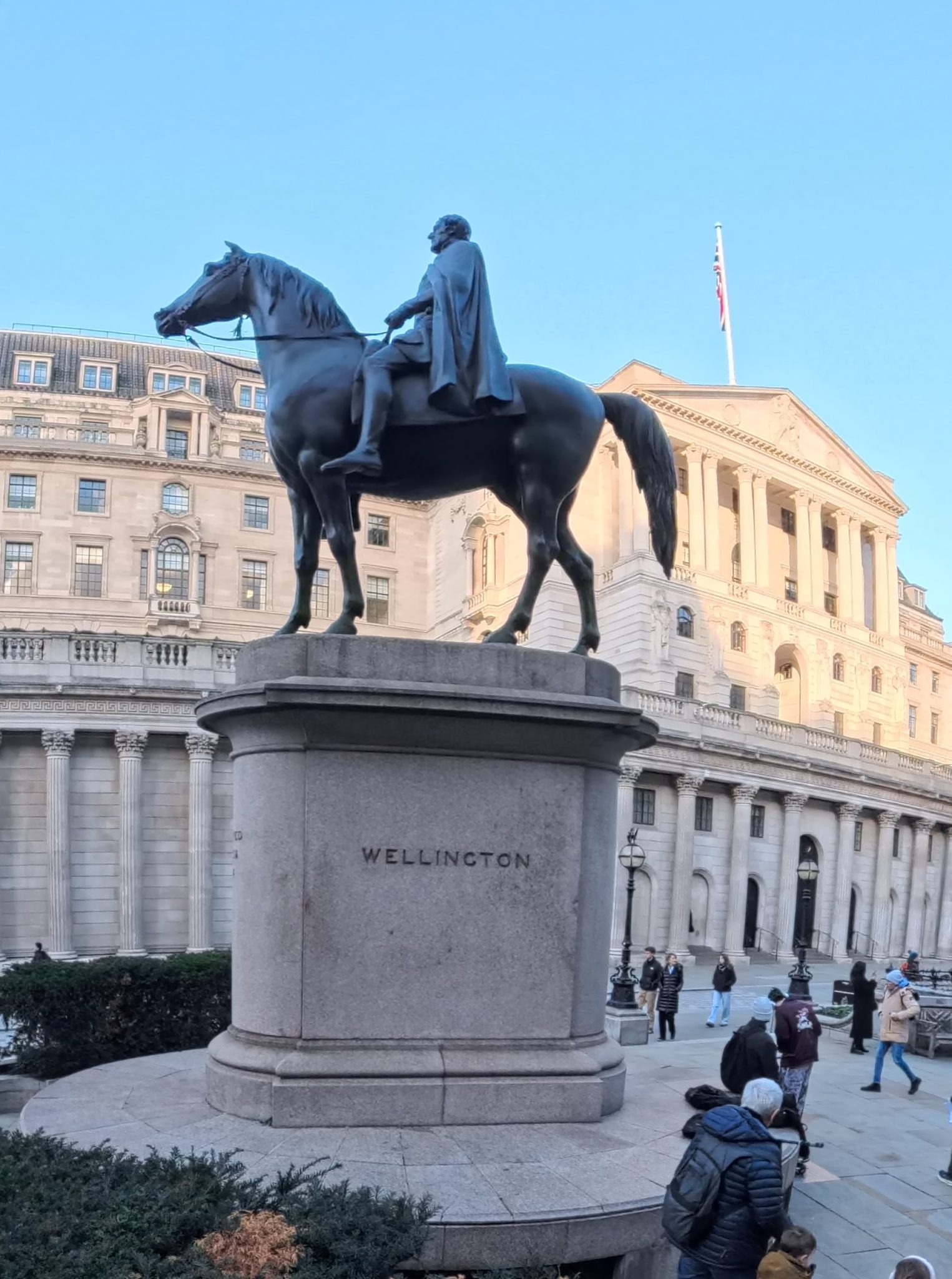
The Duke of Wellington statue is an equestrian monument standing directly in front of the Royal Exchange, looking out over Bank Junction at the meeting point of the City’s main financial streets. It depicts Arthur Wellesley, 1st Duke of Wellington, the general who defeated Napoleon at Waterloo and later served as prime minister.
The bronze figure, cast from captured enemy cannon, stands on a high stone plinth inscribed “Wellington” and dates from the mid‑19th century. It was erected by the City in gratitude for his support in passing the London Bridge Approaches Act of 1827, which enabled the creation of King William Street and improved access to the City. Today the statue forms the central focus of the raised island at Bank, surrounded by benches, flowerbeds and entrances to Bank Underground station.
-
Bronze from captured cannonThe statue is cast from bronze supplied by the government, made by melting down captured enemy cannon taken after the Battle of Waterloo, valued at about £1,500 at the time
-
Unveiled on a symbolic anniversaryIt was unveiled on 18 June 1844 – exactly 29 years after Wellington’s victory at Waterloo in 1815 – with the Duke himself attending the ceremony, along with visiting dignitaries such as Frederick Augustus II, King of Saxony
-
Paid for by City and public subscriptionThe total cost of the statue was around £9,000; the City of London Corporation contributed £500 and the rest was raised by public subscription, while the government donated the metal
Change Alley
Change Alley is a narrow, partly covered passageway linking Cornhill with Lombard Street, right in the heart of the City of London’s historic financial district. Once known as Exchange Alley, it was lined with coffee houses such as Jonathan’s and Garraway’s, where merchants, brokers and speculators gathered to trade news, shares and commodities in the 17th and 18th centuries.
The alley became infamous as one of the main stages of the South Sea Bubble of 1720, when frenzied dealing in South Sea Company stock led to ruin for many investors. Although later fires and rebuilding altered its appearance, Change Alley still preserves the tight, hemmed‑in feel of an older City, with entrances on both Cornhill and Lombard Street. Today it serves as a minor cut‑through between major financial streets, its modest shopfronts and signage hinting at the role it once played in the birth of modern stock trading
-
Coffee‑house cluster and early stock tradingIn the 17th and 18th centuries Change Alley (then Exchange Alley) was lined with famous coffee houses including Jonathan’s and Garraway’s, which acted as informal exchanges where merchants, brokers and speculators traded shares, commodities and news. Jonathan’s Coffee House in particular became a key gathering point for stockbrokers and is often seen as a forerunner of the London Stock Exchange.
-
Epicentre of the South Sea BubbleChange Alley was one of the main stages of the South Sea Bubble of 1720, when feverish buying and selling of South Sea Company stock sent prices soaring to over £1,000 a share before a dramatic collapse ruined many investors. The episode was later immortalised in satirical prints and in Edward Matthew Ward’s 1847 painting “The South Sea Bubble, a Scene in ‘Change Alley in 1720”, now in the National Gallery.
-
Fire and rebuilding in 1748On 30 March 1748 a fire that began in a peruke‑maker’s shop in Exchange Alley destroyed between ninety and one hundred houses and premises in the alley and nearby streets, killing several people. The blaze consumed multiple taverns and coffee houses, including Jonathan’s, Garraway’s, the Swan, the Fleece and the George and Vulture, and the area had to be extensively rebuilt afterwards.
-
Garraway’s Coffee House and teaGarraway’s Coffee House in Change Alley was famed not only as a venue for auctions and business dealing but also as one of the first places in England where tea was sold, helping to introduce it to London society. By the 19th century Garraway’s was known for its sherry, ale, punch and sandwiches, with a first‑floor sale room and a small auctioneer’s rostrum used for regular sales.
James Henry Greathead Statue (Cornhill)
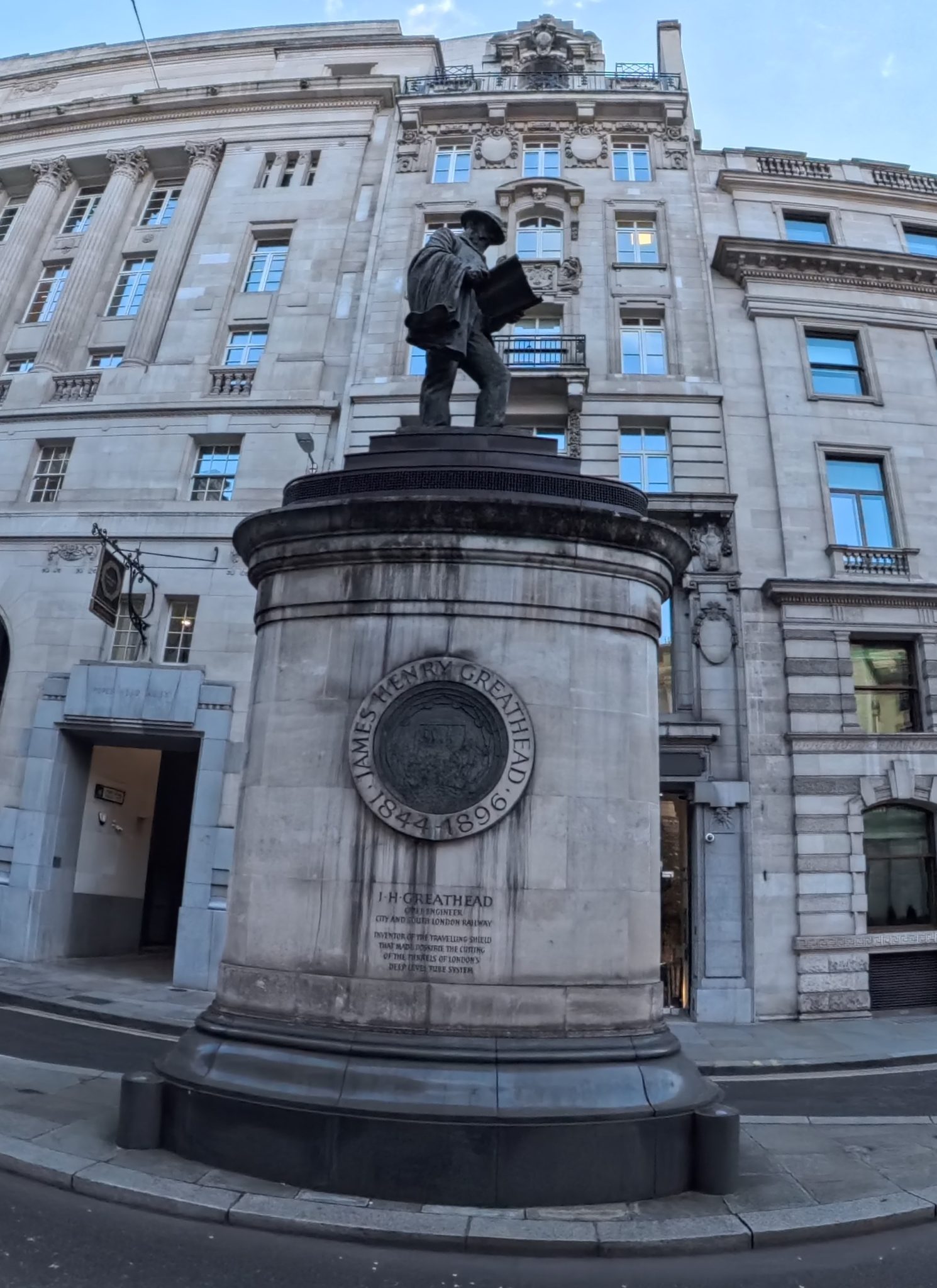
A monument to the engineer who perfected the tunnelling shield that made deep-level Tube lines possible, its plinth doubling as a discreet ventilation shaft for the Underground after post-1987 fire safety reforms.
Tivoli Corner
A curved neoclassical façade at the corner of Princes Street and Lothbury, inspired by Rome’s Temple of Vesta and reflecting the layered history of Sir John Soane’s original Bank design later remodelled in the 1930s.
Bank of England Museum
A museum tracing the Bank’s evolution since 1694, with gold bars you can touch, historic banknotes and interactive exhibits exploring crises, inflation and the hidden machinery of monetary policy.
Cornhill
One of London’s oldest market streets, named for its medieval grain trade and later home to coffee houses like the Jamaica Wine House that became informal dealing rooms for merchants, brokers and early financiers.