Rethinking Banks for a More Natural World
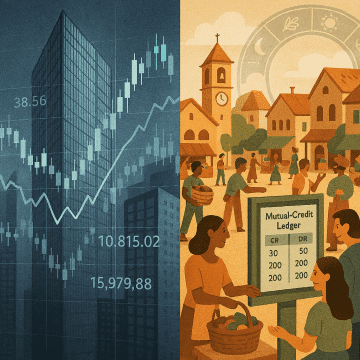
Modern banking works like a time machine: it pulls money from the future into the present and sends the bill forward. Loans, bonds and mortgages are all ways of spending tomorrow’s income today. Too often, this means taking from the future – drawing down soils, burning through resources, and loading debt onto people who haven’t been born yet.
But a time machine does not have to be extractive. We could design banks and credit systems so that, instead of mainly harvesting the future, they actively give to it – repairing ecosystems, strengthening communities and leaving more options for those who come after us. This article sketches how a more natural banking system might look if its core purpose was to invest in the future, not strip‑mine it.
Giving to the Future: Practical Directions
1. Finance that grows living systems
Credit can be directed first to projects that leave the world richer in life:
-
Regenerative agriculture and agroforestry that improve soil, water and biodiversity over decades.
-
Restoration of wetlands, forests and watersheds, with returns shared between communities and ecosystems.
-
Buildings and infrastructure designed for durability, repairability and low energy use over their entire life.
Here, repayment is not only financial; it includes measurable improvement in the land and community.
2. Products designed on long horizons
Instead of short‑term extraction, banks can offer products that reward patience and long‑term care:
-
Savings and investment accounts with better terms the longer money is committed to regenerative projects.
-
Mortgages and business loans whose conditions improve as clients meet ecological and social milestones.
-
Intergenerational funds or trusts aimed at benefits 30–70 years out, not just 3–7.
The time machine still moves value forward and back, but it is tuned to human lifetimes and beyond, not quarterly reports.
3. Community‑rooted credit
A natural system keeps money close to the places that generate real value:
-
Cooperative and community banks owned by their customers and neighbours.
-
Local and regional currencies that circulate within a bioregion, supporting local food, energy and care.
-
Mutual‑credit networks where businesses and residents extend one another interest‑free credit inside agreed limits.
These tools help communities become stewards of their own future, rather than just customers of distant capital.

4. Built‑in cycles and resets
Nature runs on cycles of growth, rest and renewal. Finance can mirror that:
-
Periodic debt relief or restructuring for households and regions hit by shocks they did not cause.
-
Time‑limited debts that cannot follow a person for life or trap a place in permanent extraction.
-
Credit rules that flex with real conditions – harvests, disasters, energy shocks – instead of ignoring them.
Resets are not moral failures; they are maintenance for the time machine so it does not grind people and ecosystems down.
5. Governance that sees beyond the spreadsheet
To give to the future, banking decisions must be informed by more than models:
-
Boards and committees that include ecological scientists, local elders, workers and community representatives.
-
Clear mandates that put ecological regeneration and social stability alongside financial soundness.
-
Transparent reporting on how each major credit decision is likely to affect land, water, climate and community over time.
This doesn’t abolish expertise; it puts it in conversation with lived knowledge and long‑term responsibility.
Turning the Time Machine Around
We can’t stop moving value through time. Any society that saves, lends and builds is already using a kind of time machine. The real choice is whether that machine mostly takes from the future or gives to it.
A more natural banking system would still issue loans, manage risk and support enterprise. But its deepest logic would be different. Every major credit decision would be asked: does this leave the soil, the water, the community and the next generation better off, or worse? Are we borrowing from our descendants, or making a down‑payment on their world?
If we can tune our financial time machine so that its default setting is to endow the future rather than drain it, banks could become something new: not just engines of extraction, but instruments of care – part of a more natural world instead of standing outside it.
Conclusion: All we need is Sound money

For any bank or credit system to genuinely give to the future, it also needs sound money – a form of money that cannot be endlessly diluted by political convenience or central‑bank decree. We have not really had that since 1971, when President Richard Nixon closed the gold window and fully decoupled the US dollar from gold, turning it into a purely fiat currency that can be created in unlimited quantities. This is where Bitcoin SV (BSV) comes in: it aims to restore Bitcoin as a scalable, stable, rules‑based monetary system that can handle global transaction volume while keeping the monetary protocol fixed. If you want to explore how BSV could function as the kind of sound money a more natural banking system would require, read my article: https://www.dragonloretours.com/the-real-bitcoin-bitcoin-sv-bsv.