Mythological Origins of St George & the Dragon
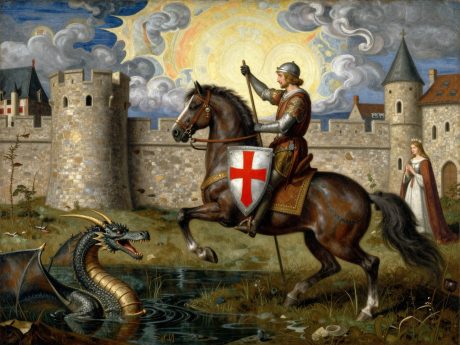
Across the ancient world, powerful gods and heroes appear again and again as dragon‑slayers: figures who subdue serpents, sea‑monsters, and chaos to make the world flourish. Over time this pattern crystallises into what we might call a “divine masculine” principle.
In the story of St George and the Dragon, this very old pattern is not replaced but re‑invoked in a new guise. On one side stand storm‑gods like Marduk and Baal, who carve order from the primordial waters by force. On the other stands Christ, the Lamb‑warrior, who defeats the great dragon through sacrifice and self‑offering, offering a revolutionary alternative to violence, before medieval Christendom calls the old warrior language back to the centre in the figure of St George. Beneath all of these lies an older intuition: reality is born from the waters.
Primordial waters: the deep before gods and worlds
In many creation stories there is, at first, a no-thing—only the primordial waters: a boundless, undifferentiated depth, before land, sky, gods or creatures have yet emerged. In one of the oldest written myths from Mesopotamia we hear of Apsu and Tiamat, mingled fresh and salt waters, as the original condition before the gods or the world existed. Egyptian religion imagines the dark flood of Nun, from which the first mound of land rises and the sun‑god appears. The opening of Genesis pictures “the deep”, with the spirit of God hovering over the waters before any separation of sky and earth.
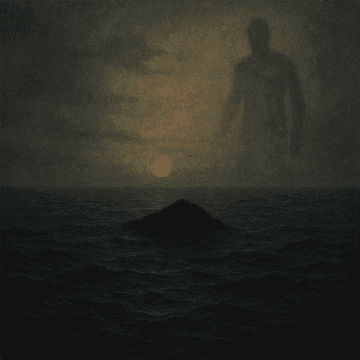
These primordial waters are not just “a lot of water”. They symbolise the unformed: the unconscious, nature before shape, pure potential which can bring forth worlds or swallow them. They are womb and abyss at once, endlessly fertile yet capable of dissolving any form that arises. In mythic language they are usually feminine: the sea‑mother, the earth‑mother, the Great Deep, and often the dragon herself.
Creation begins when something steps forward in relation to this depth—when the first distinction is drawn, the first separation made, the first word spoken into the waters.
Upper and lower waters: sky‑father and earth‑mother
The first move of creation is often a division of waters. The deep is split into “waters above” and “waters below”; a space appears between them where a world can be built. This split becomes a vertical axis, and quickly becomes a gendered story.
The upper waters—cloud, rain, lightning, storm—belong to a sky or storm god. He rides on the clouds, thunders, wields the lightning‑bolt, controls when and how the rains fall. The lower waters—sea, rivers, lakes, and the soaked earth that receives them—are the domain of the feminine: mother earth, sea‑goddesses, river nymphs, the dark, fertile soil.
Rain is the archetypal masculine movement: an active descent, a fertilising fall from above. Earth and sea are the archetypal feminine: receptive, containing, gestating life in darkness. Greek myth makes this explicit in the story of Zeus and Danaë, where the sky‑father comes to her as a shower of golden rain. The same logic underlies Near Eastern storm‑gods, who “own” the rains and decide when the earth will be fertile and when she will know drought.
Psychologically, the upper waters can be read as logos: order, law, time, measurement, the conscious mind that marks and divides. The lower waters are the unconscious: depth, flux, instinct, the raw powers of nature and psyche. The world we know is born where these two begin to interact, when the heavens speak into the waters and the waters answer.
The dragon and the logos
The dragon appears at the threshold where awareness awakens: where land first rises from water and self‑consciousness first looks out over the unknown. The dragon, then, is a knot of meanings: chaos, life, dangerous water, untamed nature, the unconscious. It can be perceived as “evil”; it is feared because it can never be fully known, and while order can be brought to it, it is a relentless task. The dragon therefore is perceived as evil or chaos taking form as the sea, terible storms, the forest, the flood, libido, rage, and that which overwhelms.
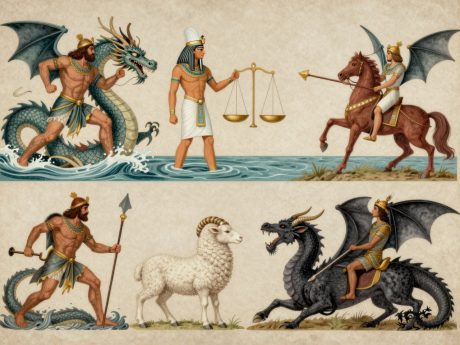 The dragon‑slayer is the masculine principle, the logos in the Greek sense, that steps into that chaos to create order from it. Logos confronts, names, divides, and arranges. Sometimes it does so violently, by cutting and binding. Sometimes it moves more creatively, balancing and harmonising with it, as exemplified by gods like Shiva from India who dances to create order, and wears the serpent as a symbol of his mastery.
In the Christ story, logos takes a different path altogether, meeting the dragon through sacrifice and transformation rather than force, while St George returns to the older warrior style, re‑invoking it in Christian form but with more emphasis on chivalry and valour.
The turning of the great clock: Taurus, Aries, Pisces
Over long spans of time, the face of this masculine logos changes. The slow precessional drift of the equinoxes through the zodiac provides a symbolic language for these shifts: the “great clock” turning behind the myths.
In the Age of Taurus, the Bull, humanity settles into agriculture and pastoral life. The divine appears as bull‑strength and fertility: heavy power close to the earth, pulling ploughs, guarding herds, overflowing with seed. Bull‑gods and bull‑slaying rites speak of a time when the primary task is to master and channel raw fertility into order and surplus.
In the Age of Aries, the Ram, the emphasis moves towards martial energy. The ram is defined by its charge: horns lowered, smashing into rivals. This is the age of great warrior cultures and expanding empires, where the masculine ideal is the armed, conquering figure and sacrificial rams stand at the centre of religious life. Law, borders, and empire are carved into the world by force; the dragon‑slayer is now very clearly a warrior.
With the Age of Pisces, the Fishes, a different tone enters. Pisces is watery and dual: two fish bound together, swimming in different directions, inhabiting the liminal space between surface and depths. The Christ story arises in this frame: the fisher of people, the teacher on the lake shore, the miracle of loaves and fishes. The Christ principle brings the divine into the waters rather than staying above them. It is still a confrontation with chaos, but one that moves by immersion, compassion, and transformation rather than by straightforward conquest.
Marduk and Baal: carving order from the sea‑mother
In the Babylonian Enuma Elish, Marduk is the young champion of the gods who takes on the primordial sea. The mingled waters of Apsu and Tiamat give rise to the divine generations, but tension grows. Apsu is killed; Tiamat rises in fury, taking the form of a huge sea‑dragon, leading an army of monsters. Marduk confronts her with storm‑winds and weapons.
He defeats Tiamat and cuts her in two. From one half he forms the sky, from the other the earth. Her eyes become the sources of rivers. The architecture of the world, in this vision, is literally the dismembered body of the sea‑mother. Reality is made from the slain feminine waters. The dragon is killed and fixed into walls, ceilings, and channels. Order is enacted through separation and violence.
Baal, the Canaanite storm‑god, stands in a similar role. He battles Sea (Yam) and Death (Mot), associated with sterility and drought. His victories bring rain to the land and ensure the cycle of crops; his defeats or descents coincide with barrenness and famine. Lightning is his weapon, thunder his war‑cry. Here too, the masculine is the storm‑hero who forces chaotic waters into channels and seasons.
In both cases, logos appears as a cosmic warrior who subdues the waters so that the earth‑mother can be fruitful in predictable ways.
Maat and the art of balance
Egypt offers another way of imagining this work. The primordial waters of Nun surround everything, but they are not slain; they are held in relation. When the first god rises from Nun and the first mound of land appears, he brings forth Maat: the principle and goddess of truth, justice, proportion, and balance. Maat is the pattern by which the universe can exist rather than fall back into the waters.
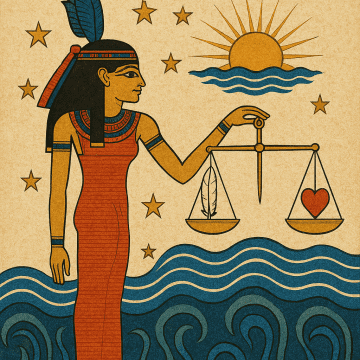
Maat governs the regular flooding and receding of the Nile, the steady procession of the stars, the right ordering of human society. To “live in Maat” is to act in harmony with the deep structures of reality, such that the ever‑present chaos does not break in and overwhelm. Pharaoh’s task is not to fight the waters, but to maintain right relationship with them—to give the gods their due, to uphold justice, to ensure that what is owed is given, so that Nun remains a background of potential rather than a devouring flood.
This is a different style of dragon‑work. The chaos is not hacked to pieces; it is kept in a dynamic balance. The masculine principle here is not just the warrior but the guardian of proportion, ensuring the powers of water and wildness stay within bounds.
Waters, unconscious, and the psychological dragon
Depth psychology gives new names to these old images. The sea and the deep waters stand for the unconscious: the layers of psyche that precede and underlie conscious thought. They contain instinct, memory, inherited patterns, trauma, archetypal images—everything that shapes us before we choose.
In this language, the dragon is the complex, the knot in the unconscious where fear, desire, anger, and forgotten power tangle together. It can erupt as addiction, violence, or terror; it can also erupt as creativity, eros, and vision. The “dragon‑slayer” is any principle—personal or divine—that turns toward these depths, confronts what is there, and brings some of it into language and form.
The question becomes: how do you approach your dragon? Do you suppress and split, Marduk‑style? Do you try to live in balance, Maat‑style? Find harmony like Shiva through responsive movements (dance) . Or do you, Christ‑style, descend into the pain, endure, and transmute it from the inside?
Christ: a revolutionary way of dealing with the dragon
When Christianity arrives, it inherits both strands: the violent dragon‑slayer gods and the subtler balancing deities. But the Christ story introduces a third, more radical move.
In the Book of Revelation, the great red dragon is named as “that ancient serpent called the devil, or Satan,” the adversary and accuser. A child “destined to rule all nations”—read as Christ—is threatened, but the dragon is ultimately thrown down. The text explicitly links this defeat to “the blood of the Lamb” and the testimony of those who do not cling to their lives. Here the dragon is overcome not by a bigger sword, but by self‑offering.
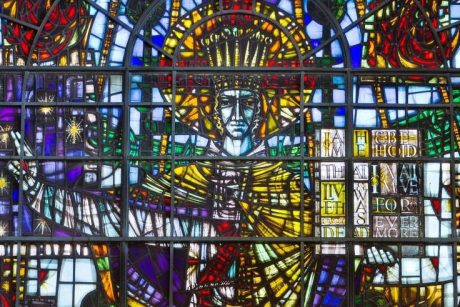
The image of Christ as Lamb gathers up the whole tradition of sacrificial animals and pushes it to a new conclusion. The divine does not demand someone else’s blood; the divine offers its own. Instead of standing outside the primordial forces to carve them into shape, the Christ principle descends into the deepest places—betrayal, injustice, abandonment, death—and passes through, returning alive. Victory comes not by cutting off the dragon’s heads, but by robbing the dragon of what it feeds on: fear, guilt, resentment, the refusal to forgive.
The Gospel episode where Christ casts seven demons out of Mary Magdalene can be read as a human‑scale version of this. Seven demons mirror, symbolically, the seven heads of Tiamat: a many‑headed chaos lodged in one person. Christ does not go hunting sea‑monsters; he meets that chaos in a human face, names it, and restores her. The “heads” are not annihilated but reintegrated into a healed personality.
This is a different style of logos: still masculine in its willingness to face horror and take responsibility, but moving by compassion and transformation rather than domination.
St George: the old pattern, re‑invoked
Centuries later, in a thoroughly martial Europe, the radical Christ‑way often appears too subtle, too impractical. Kingdoms and borders are still decided by swords. Knights need a story that speaks their language. So the old dragon‑slayer pattern returns, now carrying a cross.
In the legend, St George is a knight who rides out to face a dragon threatening a city and a princess. He wounds the dragon, has the princess lead it by her girdle, and then kills it in front of the people. The city is saved, the people convert, and George refuses reward, directing wealth to the poor.
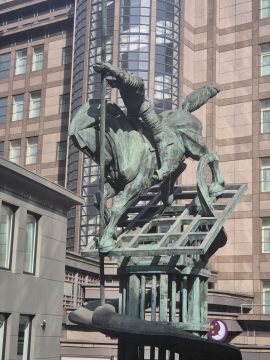
On the surface this is a straightforward heroic tale. But mythologically, it is a re‑invocation of the ancient pattern under Christian signs. George’s method is closer to Marduk’s than to the Lamb’s: he spears the dragon. Yet his motives, his self‑sacrifice, and his refusal of wealth place him within the Christ story. He rides under Christ’s banner, but expresses that banner in the older language of the warrior.
We might say: St George is Christianity speaking Marduk’s dialect. The culture, still shaped by Aries‑style values of war and honour, reaches instinctively for the armed hero. The Christ principle of transforming the dragon from within remains, but perhaps more at the level of personal endeavour.