Earth Angels
Emily Young’s angel heads at Paternoster Square are among the most quietly arresting works of public sculpture in the City of London: five immense stone heads raised on columns beside St Paul’s, archaic and calm, at once human, geological, and faintly otherworldly. They belong to a broader body of work in which 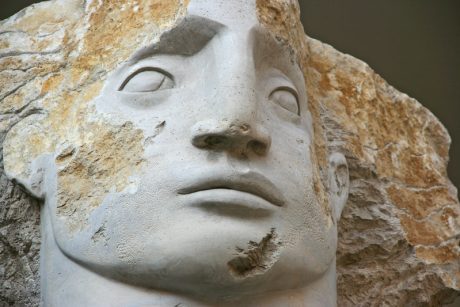 Young uses stone not to create polished decorative figures but to reveal time, gravity, memory, and a deeper dignity in the human form.
What Emily Young says
Young’s clearest direct statement about these angel heads comes through a frequently quoted remark: “The looks on the faces of the angels are not planned as such, they arrive and surprise me often with their softness and sadness, and strength and calm.” That sentence is important because it shifts the emphasis away from rigid iconography and toward discovery.
Her broader statements about carving help explain the deeper ethos behind the Paternoster angels. Young has said: “I carve in stone the fierce need in millions of us to retrieve some semblance of dignity for the human race in its place on Earth.” She continues by contrasting humanity at its worst, marked by “rapacity, greed, and wilful ignorance,” with humanity at its best, capable of love for the planet and reverence for life. In another closely related statement, she describes her work as “a kind of temple activity now, devotional,” in which carving reveals the mineral layers and geological history already present within the stone.
This language is not incidental. It frames the angels not merely as decorative public art but as acts of witness: witness to time, to the earth, and to the possibility that human beings might still be seen with dignity rather than only with suspicion or contempt. The Beshara interview on her work reinforces this reading by stressing that her angels emerge out of the earth, with portions of the stone deliberately left uncut so the material continues to “show its history” and tell its own story.
Why they look as they do
The peculiar power of the Paternoster angels lies in the tension between face and rock. Young’s process does not erase the block in order to produce a wholly naturalistic likeness; instead, it preserves the stone’s roughness, veining, and asymmetry, so that the face appears half discovered, half released. That is why the angels can strike viewers as ancient, extraterrestrial, archaic, or prophetic all at once. Their “otherness” is not the result of a science-fiction reference but of a sculptural language that refuses prettiness and allows geological mass to remain visible.
This also helps explain why many people react so strongly to them. The heads do not smile, flatter, or entertain. Raised above eye level, they occupy the role of watchers, witnesses, or guardians, but they do so without the theatrical wings or overt narrative cues usually associated with angelic art. They ask for contemplation rather than consumption, and in a fast-moving corporate quarter that alone can feel disruptive.
What the work does for people
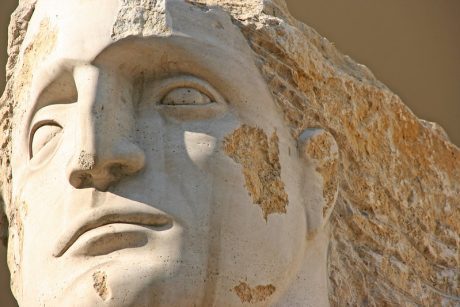 For some viewers, that effect is consoling. The faces have been described as carrying softness, sadness, strength, sympathy, and calm, and those are striking qualities to encounter in a district so often defined by transaction and speed. For others, the response is more uncanny: the heads seem alien, severe, or even unsettling. Yet that unease is part of the work’s success, because sacred or numinous art has often depended on estrangement rather than comfort. Several have said that it reminds them of the Navi people from the Avatar movies.
Why they matter now
Young’s own language about human dignity, planetary belonging, and the revelatory depth of stone feels especially resonant in a period marked by ecological anxiety, political aggression, technological acceleration, and spiritual fatigue. Her angels do not preach solutions, but they do offer a different posture: steadiness instead of frenzy, attention instead of distraction, reverence instead of extraction. In that sense they are relevant not because they illustrate current events, but because they oppose the habits of mind that current events often intensify.
Beside St Paul’s Cathedral and within one of the great financial districts of the world, these heads quietly stage a confrontation between two ideas of value. One is instrumental, rapid, and monetised. The other is patient, material, devotional, and rooted in deep time. Young’s stone angels do not abolish the first world, but they remind those who pass beneath them that another scale of meaning still exists.