Heaven on Earth: Arthur, the Zodiac, and the Sun Kings
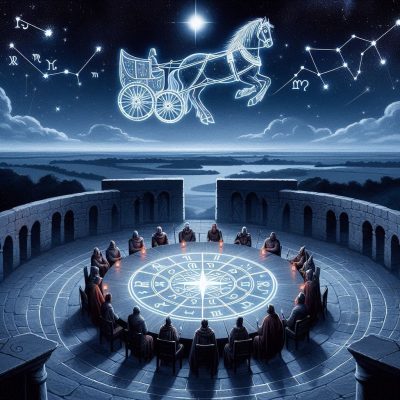 Across Europe and the Near East, myth and astronomy have long reflected each other: earthly kings mirror heavenly powers, and stories encode the motions of the stars. The legend of King Arthur and his Knights can be read as one of these sky‑stories, circling around the zodiac and the northern constellations like a cosmic Round Table.
Arthur in the Northern Sky
The name “Arthur” is commonly linked to the Celtic word arth (“bear”), and since antiquity the Great Bear constellation, Ursa Major, has been associated with the hero‑king. In Britain its seven bright stars are known as the Plough or Big Dipper, but older traditions also call this asterism “Arthur’s Wain” – Arthur’s Wagon or Chariot – imagined as his shining cart circling endlessly around the Pole Star.
In Welsh lore, the whole circumpolar region is sometimes called Bwrdd Arthur – “Arthur’s Table” – a round, turning kingdom of stars around the still point of the North. The circular path of Ursa Major around the Pole thus becomes “Arthur’s Round Table”, a sky‑version of the court where all companions are equal and the king presides at the center.
Nearby, the bright star Arcturus – from Greek arktos (“bear”) and often glossed as “guardian of the Bear” – sits in the constellation Boötes, the herdsman or watchman. This “bear guardian” reinforces Arthur’s role as protector and central figure, a celestial charioteer watching over the Great Bear as it wheels around the pole.
The Celtic Cross and the Cosmic Center
Celtic spirituality also expresses this cosmic center in the form of the Celtic Cross: a cross set within or upon a circle. The four arms mark the cardinal directions or the four elemental powers, while the encircling ring suggests u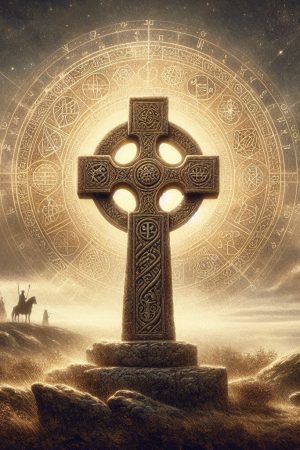 nity, eternity, and the sun’s unending path.
Many modern interpreters see the Celtic Cross as a map of the world‑axis: the vertical beam as the line between heaven and earth, the horizontal beam as the path across the world, and the circle binding them together at the heart. This echoes the image of Arthur as a pole‑star king at the center of a turning heaven, with his knights – like stars – arranged around him in a sacred circle.
The Round Table as Zodiac Wheel
When medieval writers describe Arthur’s Round Table, they stress two things: its perfection as a circle, and the equality of all who sit there. In zodiacal terms, the Round Table becomes a symbolic star‑wheel: Arthur at the center as Sun or pole star, surrounded by twelve knightly archetypes corresponding to the twelve signs.
Esoteric commentators have explicitly mapped this structure: the “nights” or knights of the Round Table as the twelve signs of the zodiac, each with distinct virtues and trials, revolving around a central royal figure. Arthur’s kingship then mirrors the Sun king motif from Egypt and the Mediterranean – the radiant sovereign who holds cosmic order together as the constellations, seasons, and human affairs revolve around his steady presence.
Quests of the Knights and the Solar Journey
Seen this way, the adventures of Arthur’s knights can mirror the Sun’s annual journey through the zodiac. Each knight’s character and challenge reflect a different “sign‑stage”: courage and chivalry, testing of loyalty, trials of passion, and confrontations with shadow and betrayal.
The Grail Quest, often associated with spiritual fulfillment and the end of an era, aligns neatly with the energies later astrologers attach to Pisces – compassion, sacrifice, and the yearning for ultimate union. Darker episodes, such as the fatal clash with Mordred and the fall of Camelot, resonate with Scorpio‑like themes of death, betrayal, and rebirth, suggesting that even the brightest solar kingdom must pass through its underworld phase before renewal.
In this astrological reading, Arthur is not just a British war‑leader but a bridge between heaven and earth, a Sun king whose round court is both royal hall and star‑circle. The Great Bear as Arthur’s Wain, the circumpolar sky as his Round Table, the Celtic Cross as world‑axis, and the twelve knights as living zodiac all point to a single idea: the king at the cosmic center, holding the turning of the heavens and the fate of his people in one shining, circular design.
-
Allen, R. H. Star-Names and Their Meanings – section on Ursa Major (Arthur’s Wain, Charles’s Wain, links to the Great Bear).
-
“Ursa Major – the Great Bear.” SkyGuide (online star guide, British names like the Plough, Arthur’s Wain).
-
“Star Lore of All Ages: Ursa Major.” Wikisource – overview of old European names for Ursa Major, including wain/chariot traditions.
-
Sarah Fuhro, “Astrology of Arthur” – blog connecting Arthur, the Round Table and zodiac archetypes.
-
“Arthur, His Round Table and the Zodiac.” Passion for Fresh Ideas – explicit Arthur–Round Table–zodiac wheel interpretation.
-
“Nights Around the Round Table – A Short Circumpolar Quest.” A New Astrology – Arthur and the circumpolar constellations around the Pole.
-
“The Round Table.” Keys to the Mystery – esoteric discussion of Round Table, Grail and zodiac symbolism.
-
“The British Landscape Zodiac.” Francis Bacon Research Trust – broader British zodiac discussion you can nod to when mentioning Glastonbury and landscape zodiacs.
-
“Celtic Cross Meaning, History, and Christian Symbolism.” Grace Fiber – good for cross‑and‑circle, cosmic axis language.
-
Celtic jewellery history articles (e.g. Irish/Scottish jewellers) – for background on the cross‑within‑a‑circle as solar/world‑axis symbol in Celtic culture.