Chalice Well & Gardens
Chalice Well is a famed red spring flowing through tranquil gardens, long associated with healing, Arthurian legend and the Grail. Paths, pools and flower beds create a sheltered space for reflection where many visitors come to drink, meditate and attune to the softer, heart-centred side of Glastonbury’s energy.
Address: Chalice Well & Gardens, Wellhouse Lane, Glastonbury BA6 8BL, United Kingdom
Interesting Facts:
-
Ancient red spring and geologyChalice Well is a chalybeate spring, meaning the water is naturally rich in iron, which stains the stonework and channels a deep red‑orange. The flow is remarkably constant throughout the year, and some analyses suggest it has been rising here for at least two millennia. When you point out the red deposits on the rills and pools, you can link it to the idea of “blood of the earth” feeding an old sacred site long before the Christian stories were added.
-
Joseph of Arimathea and the Grail legendOne long‑standing Glastonbury tradition says that Joseph of Arimathea, after the Crucifixion, brought the Holy Grail to this area – either the cup of the Last Supper or the vessel that caught Christ’s blood. In some versions, he buried or washed the Grail at this very spring, and the iron‑red water is explained as a sign of that contact. You can frame it clearly as legend, but emphasize how this story ties Chalice Well directly into the wider Arthurian and Grail cycle, turning a natural spring into a key “node” in Britain’s sacred geography.
-
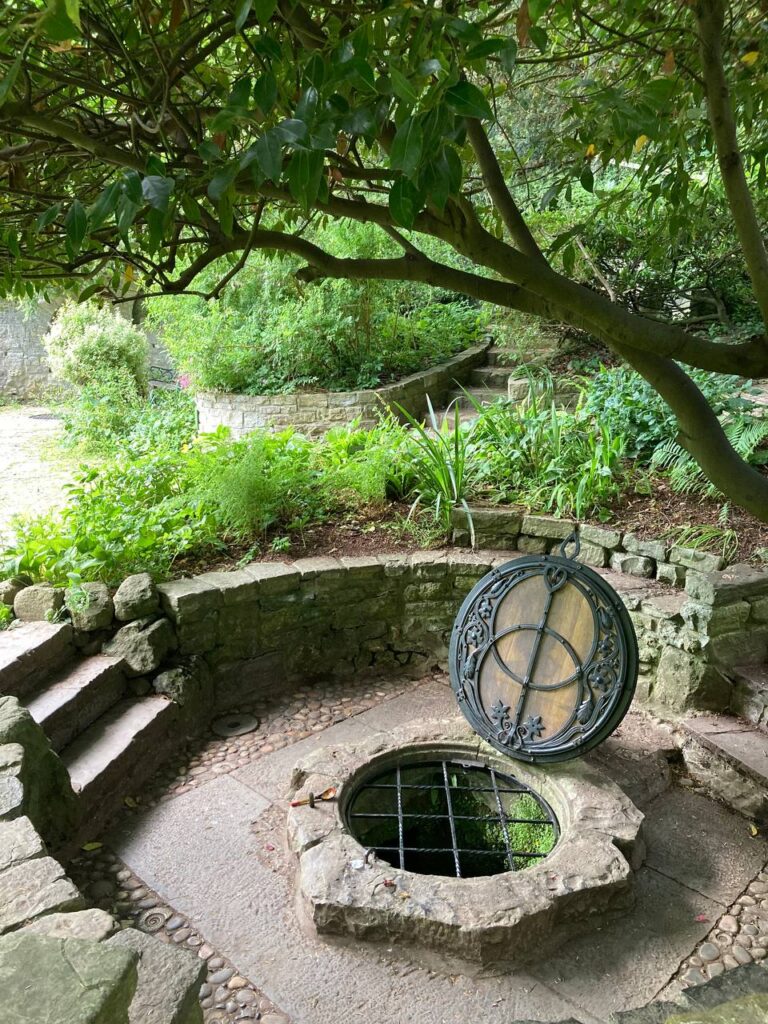
Vesica Piscis lid and symbolismThe circular wellhead is covered by the famous metal lid showing two overlapping circles (the vesica piscis) with a central vertical sword or lance. The overlapping circles can be described as a meeting of two worlds – spirit and matter, heaven and earth, or human and divine – with the almond‑shaped centre as the gateway between them. The sword or spear can be read in several ways: as the “bleeding lance” of Grail lore, as a symbol of discernment and truth, or more simply as a reminder of the Christian cross. It gives you a precise visual: “This design sums up the whole place – two worlds meeting at a single source.”
-
Peace garden and shared silenceThe gardens today are managed as a World Peace Garden by a trust whose motto is “Many paths, one source.” They are explicitly open to visitors of all faiths and none, provided they treat the space quietly and respectfully. At set times (often midday), staff and visitors are invited to hold a shared minute of silence for peace; you can mention that people are free to join in their own way – prayer, meditation, or simply standing still by the water.
-
Spaces for different kinds of useAs guests move through the garden, the same red water appears in different forms, each with a purpose: the enclosed wellhead area for stillness and contemplation; the Lion’s Head fountain where visitors can drink the water from a cup; the shallow healing pool where people may paddle or sit with feet in the water; and the lower pools and flow‑forms where the water runs in S‑shaped channels to aerate and slow it, creating a gentle soundscape.