The Point of Descent: When River Sources Were Sacred
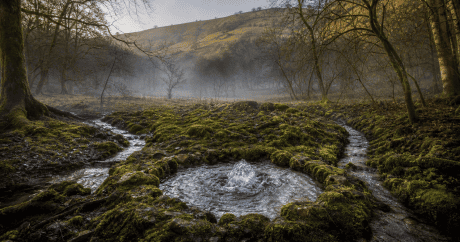 At Alton Barnes and Alton Priors in Wiltshire, a small chalk stream runs between two villages, quiet enough that many people would pass it without a second thought. Yet this modest channel is one of the sources of the River Avon, and if you stand beside it for a moment you can watch the river being born. Every few seconds, small bubbles break the surface as water escapes from the chalk aquifer beneath the ground. This is the literal moment groundwater becomes a river, the hidden veins of the earth rising into daylight and beginning their long journey south toward the sea.
Places like this have always carried more than practical importance. A river source is not just where water starts flowing; it is the point from which everything downstream receives life. Villages, fields, crossings, mills, fisheries, and eventually towns all depend, in one way or another, on what begins in such unassuming ground. It is not difficult to see why so many cultures treated springs and headwaters as charged places, set apart from ordinary landscape and closer to the boundary between worlds.
That is the idea that may be called a point of descent: the place where a divine or celestial power first enters the earthly world. The phrase is interpretive rather than technical, but it expresses something ancient and recognisable. Again and again in premodern religion, the source of a river appears not as a random accident of geology but as a threshold. Water rises from darkness into light. The invisible becomes visible. A hidden power becomes a force that can feed a whole landscape.
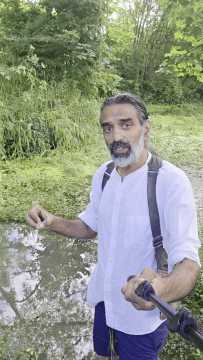 This helps explain why springs, holy wells, and river origins were so often marked with shrines, offerings, temples, or later churches. The beginning was the holiest point because it seemed nearest to origin itself. If a river was alive, then its source was its first breath. If a landscape was nourished by sacred presence, then the spring was the place where that presence first crossed into matter.
The place-name Alton itself deepens that sense of rootedness in water. Local historical commentary points to an Old English derivation connected with streams or springs, with early forms such as Aweltone and the likely meaning of a settlement defined by its waters. In a landscape where numerous local sources give rise to the Avon, that is not an incidental detail. The very name preserves memory of a village understood through the water that emerges there.
The river’s name is older still. Avon comes from the Brittonic or Celtic word abona, simply meaning “river,” a root preserved in Welsh afon and related forms elsewhere in the Celtic languages. In that sense, “River Avon” is one of those old tautologies that survive when one language inherits a place-name from another: it effectively means “River River.” Yet that apparent simplicity hints at something deeper. The word does not describe one river alone, but the idea of river itself, as though the stream before you were not merely a local feature but a manifestation of a more ancient category of life and movement.
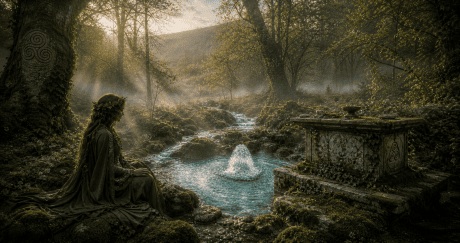 From there it is a short step into the world of river goddesses. Across Celtic and Romano-Celtic religion, rivers and springs were often personified, revered, and associated with female divinities. One of the most intriguing figures in this wider sacred geography is Abnoba, a Gaulish goddess associated with forests, mountains, and rivers, especially in the region of the Black Forest. Her name has often been linked by scholars to the same broad water-root found in abona, and later Roman inscriptions identify her with Diana in the form Diana Abnoba, showing how local spring and river cults could be absorbed into the Roman religious world without losing their original character.
It would be too much to claim that the Avon in Wiltshire was simply “the river of Abnoba,” or that every British Avon preserves a direct cultic memory of that goddess. The evidence does not take us that far. But the linguistic kinship is suggestive, and more important than any single identification is the wider pattern it reveals. In the Celtic world, rivers were not inert channels. They had names that were also words, and often words that carried divine or numinous associations. A spring could be a threshold, a source could have a guardian, and a river might be understood as a living presence moving across the land.
That older instinct still makes intuitive sense when standing beside a source like this one. The spring at Alton Barnes and Alton Priors does not look grand. It does not announce itself with cliffs or cataracts. Instead it emerges with a kind of secrecy: a bubbling, a release of air, a subtle uprising from chalk and soil. Yet there is something almost liturgical in that modesty. Here the river does not thunder into existence; it discloses itself. The beginning comes quietly.
And perhaps that is why such places continue to feel sacred even when their old rites are forgotten. The modern visitor may speak of hydrology rather than spirits, aquifers rather than goddesses, but the underlying experience remains remarkably similar. One stands at a place where something hidden enters the visible world and begins to move outward into life. To watch a spring become a river is to witness emergence itself.
For anyone interested in sacred geography, this is where the real power of a source lies. It is not only in antiquarian fact, nor only in mythological reconstruction, but in the meeting of the two. The chalk aquifer is real. The bubbles are real. The linguistic history of Avon is real. So too is the long human habit of seeing in such places a threshold between worlds. The source of a river is where earth gives up its hidden water, but it is also where the imagination of a people recognises origin, blessing, and descent.
That is why the headwaters of a river matter. Everything downstream depends on them materially, and many cultures understood that everything downstream also depends on them symbolically. The source is the first gift. The first emergence. The first contact between what is below and what is above. To stand beside one of the sources of the Avon is to stand at a beginning, and beginnings have always been holy.
-
Alton Barnes & Alton Priors (place-name and springs) Alton Parish Council, St Mary’s and All Saints – Parish History.
- https://insearchofholywellsandhealingsprings.wordpress.com/tag/alton-priors/
-
Chalk aquifer and springs (general geology)
-
Avon / abona etymology Encyclopaedia Britannica, Ninth Edition, Avon.
-
Abnoba and Diana Abnoba Wikipedia, Abnoba.
-
Celtic river and spring goddesses Wikipedia, List of Celtic deities.