Templars of Troyes to Champagne Supernova: The Soft Power Empire
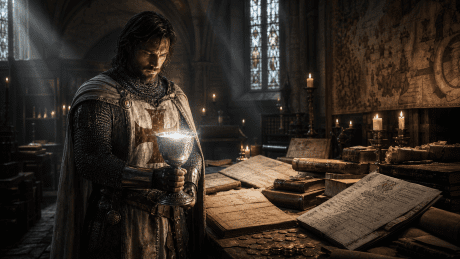 Long before the French nation-state consolidated into an absolute monarchy, a rival superpower was quietly brewing on the fertile plains east of Paris. This empire did not rule through vast standing armies or royal lineage. Instead, it ruled through liquid capital, global trade networks, and the most potent tool of all: narrative warfare.
In the 12th century, the independent County of Champagne, anchored by its brilliant capital city of Troyes, constructed a blueprint for modern soft power. By simultaneously financing the birth of the Knights Templar and inventing the Arthurian Holy Grail romances, the Counts of Champagne created a cultural and economic supernova. It was a flash of brilliance so blindingly successful that it threatened traditional feudal authorities, ultimately provoking a ruthless destruction that scattered the world’s financial elite to the maritime ports of Italy.
Chapter 1: The Braids of the Tricasses
To understand the meteoric rise of this medieval powerhouse, one must look to the very soil from which it grew—and the linguistic history embedded in its capital.
Long before Roman legions or Frankish kings marched across the landscape, the region was the ancestral home of a fierce Celtic Gallic tribe known as the Tricasses. In their native tongue, their tribal name likely translated to “those with three tresses,” a proud reference to their distinctively braided hair.
When the Roman Empire conquered Gaul under Emperor Augustus, they recognized the strategic value of the tribe’s central settlement along the Seine, establishing a hub named Augustobona Tricassium. Over the centuries, the harsh Latin consonants softened through early French phonetic shifts. Tricassium melted into Tricassae, eventually evolving into the medieval and modern name: Troyes.
It was within the walls of this ancient Celtic settlement that the economic mechanics of the High Middle Ages would be rewritten.
Chapter 2: The Soft Power Juggernaut
By the 1100s, the Counts of Champagne found themselves in a geopolitical paradox. They were immensely wealthy, yet they were surrounded by the expansionist ambitions of the French Crown. To survive and project authority, they weaponized two revolutionary innovations: unprecedented free trade and chivalric propaganda.
The Engine of Global Wealth
Under Count Theobald II and Count Henry I (“The Liberal”), the dynasty established the famous Champagne Fairs. Operating as a rotating cycle of international markets across Troyes, Provins, Lagny, and Bar-sur-Aube, these fairs became the financial capital of the Western world.
The Counts introduced a concept radical for its time: total safety, uniform legal courts, and standardized weights for foreign merchants. This market system became so globally ubiquitous that the standard unit of measurement for precious metals—the troy ounce—takes its name directly from the city of Troyes.
The Invention of the Holy Grail
As cash flooded the treasury, Countess Marie de Champagne (daughter of Eleanor of Aquitaine) recognized that raw wealth required cultural legitimacy. She transformed her court at Troyes into an intellectual sanctuary, commissioning a brilliant local poet named Chrétien de Troyes.
Chrétien essentially invented the modern Arthurian romance. In his hands, the old, brutal, bloody reality of medieval warfare was completely sanitized. In masterpieces like Perceval, the Story of the Grail, Chrétien introduced a mesmerizing spiritual mythology. He moved literature away from knights fighting for raw plunder and toward the concept of the “pious knight”—a holy warrior chasing divine relics and serving noble ladies under the strict code of Courtly Love.
This was elite propaganda at its finest. It softened the gruesome reality of the Crusades, transformed rowdy, dangerous landless knights into civilised gentlemen, and positioned the court of Champagne as the undisputed trendsetter of European culture.
Chapter 3: The Templar Convergence
This cultural project was not happening in a vacuum. The spiritual code that Chrétien de Troyes was writing into his romances was physically manifest right outside his window in the form of the Knights Templar.
The links between the poet, the patrons, and the warrior-monks were absolute:
-
- The Shared Cradle: Hugues de Payns, the founder and first Grand Master of the Templars, was born just outside the city walls of Troyes and was a direct vassal to the Counts of Champagne.
- The Legal Birth: In 1129, the Catholic Church officially recognized the Templar Order and formalized their strict Latin Code of Conduct at the Council of Troyes.
- The Ultimate Devotion: The connection was so profound that Count Hugh of Champagne eventually abdicated his massive earthly titles, abandoned his wealth, and travelled to Jerusalem to enlist as a regular monk-soldier in the very Templar Order his family had financed.
When later medieval writers like Wolfram von Eschenbach adapted Chrétien’s unfinished Grail poems, they made a logical leap: they explicitly cast the Knights Templar as the official guardians of the Holy Grail. The fiction of Champagne and the reality of the Crusader elite became permanently fused.
Chapter 4: The Supernova Explodes
The sheer success of the Champagne-Templar axis ultimately sowed the seeds of its undoing. By combining the liquid credit of the Templar international banking network with the sovereign wealth of the Champagne Fairs, this alliance possessed a level of financial agility that traditional feudal monarchs could only dream of.
They had become a “state within a state,” answering only to the Pope, paying zero taxes, and holding the keys to global commerce. To a traditional, centralized authority like King Philip IV of France (“The Fair”), this autonomous powerhouse was a direct existential threat. He was deeply in debt, his treasury was bankrupt from endless wars, and he could not tolerate a rival soft-power empire operating inside his borders.
Philip IV launched a swift, ruthless, multi-front campaign to extinguish the supernova:
-
- The Absorption of Champagne (1284): Philip bypassed military conflict by engineering a strategic marriage to Joan I of Navarre, the sole heiress of Champagne. The independent county was legally swallowed by the French Crown. Philip slapped heavy royal taxes on the Champagne Fairs, breaking the free-market guarantees that had made them thrive, causing international trade to grind to a halt.
- The Expulsion of the Jews (1306): In desperate need of quick cash, Philip ordered the brutal expulsion of the Jewish community from France, confiscating their property and decimating the regional financial brain trust.
- The Destruction of the Templars (1307): On Friday, 13 October 1307, Philip’s men launched a coordinated surprise raid across France, arresting every Templar on fabricated charges of heresy and spitting on the cross. By 1312, the Order was dissolved. In 1314, the final Grand Master, Jacques de Molay, was burned at the stake in Paris.
Chapter 5: The Dispersal to Genoa
The destruction of the Champagne-Templar nexus did not eliminate the global economic forces they had unleashed; it merely forced them to migrate. As the French Crown choked the life out of Troyes with taxes and inquisitions, the intellectual and financial elite packed their ledgers and fled.
The physical hub of northern European trade shifted permanently to the coastal ports of Flanders, like Bruges, which established permanent, year-round trading houses to replace the seasonal fairs of Champagne.
More profoundly, financial dominance returned to the Mediterranean. Italian merchant empires—most notably Genoa and Venice—had spent over a century trading at the Champagne Fairs. Seeing the collapse of central France, the Genoese bypassed the overland French trade routes entirely. They built massive, sophisticated maritime fleets, sailing out of the Mediterranean, around the Iberian Peninsula, and straight to the North Sea.
Genoa perfected the double-entry bookkeeping, maritime insurance, and international credit systems that the Templars had pioneered. The wealth that once congregated under the patronage of the Counts of Champagne was rerouted to northern Italy, laying the literal financial foundations for the Italian Renaissance.
Epilogue: The Curse of the Bloodline
King Philip IV succeeded in crushing his rivals and absorbing their wealth, but history would deliver a swift, haunting postscript. As Jacques de Molay burned in 1314, legend states he cursed the French royal bloodline.
Whether by divine retribution or genetic misfortune, Philip IV died later that year. His three sons—Louis X, Philip V, and Charles IV—all took the throne in breathless succession. Each died young, and each failed to produce a surviving male heir. Within a mere 14 years of the Templar executions, the centuries-old Capetian dynasty was completely extinct.
The resulting succession crisis allowed the King of England to claim the French throne, plunging a newly centralized France into the catastrophic devastation of the Hundred Years’ War. The Champagne supernova had been extinguished, but the void it left behind altered the map of Europe forever.
References


The Latin Rule of the Templars (1129). Acts of the Council of Troyes.
-
- Why it matters: The official ecclesiastical records detailing the establishment of the Knight Templar code of conduct in the capital of Champagne.
Wolfram von Eschenbach (c. 1200–1210). Parzival.
-
- Why it matters: The crucial Middle High German epic that adapted Chrétien's unfinished plot, explicitly appointing the Knights Templar as the physical guardians of the Grail.
Historical & Economic Reference Works
-
- Britannica Academic. Chrétien de Troyes: Arthurian Romances, 12th Century, Courtly Love.
- Encyclopædia Britannica. The Champagne Fairs.
- Wikipedia Contributors. Champagne Fairs and Holy Grail.
Modern Historical Analyses
Benton, John F. (1961). "The Court of Champagne as a Literary Center." Speculum, Vol. 36, No. 4.
-
- Why it matters: The definitive academic paper tracing how Henry the Liberal and Marie de Champagne used financial soft power to turn their capital into an intellectual powerhouse.
Barber, Malcolm (2007). The Trial of the Templars. Cambridge University Press.
-
- Why it matters: Verifies the exact timeline of King Philip IV's financial bankruptcy, his asset seizures, and the systematic destruction of the banking order in 1307.
Verdon, Jean (2002). Travel in the Middle Ages. University of Notre Dame Press.
-
- Why it matters: Documents the shift of elite merchant routes away from Champagne toward coastal Flanders (Bruges) and maritime Genoa following royal French taxation.
Regional Heritage Databases
-
- Troyes la Champagne Tourism. The Champagne Fairs & Chrétien de Troyes Heritage.