Gateway to the Sun: The Many Meanings of Stonehenge’s Heel Stone
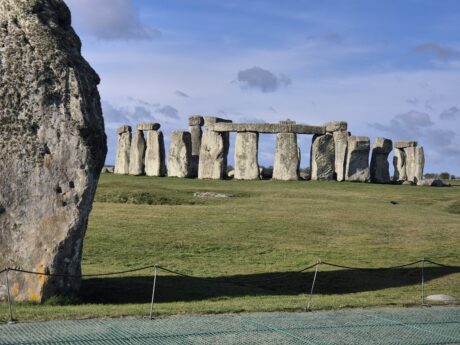
At first glance the Heel Stone looks like just one more lonely megalith standing outside the stone circle of Stonehenge, leaning at a strange angle beside the Avenue. Yet this single stone gathers around it a cluster of legends, linguistic puzzles, astronomical alignments, and modern spiritual readings. Over centuries people have tried to explain its name and purpose, and each explanation reveals more about human imagination than it does about the stone itself, turning the Heel Stone into a focal point for the wider mystery of Stonehenge.
Friar’s Heel: Folklore and the Devil’s Throw
One of the best‑known stories calls the stone “Friar’s Heel.” In this tale, the Devil is carrying the stones of Stonehenge when a curious friar starts watching him from a distance; in anger, the Devil hurls one of the stones and pins the friar by his heel, giving the stone its name. In some versions a footprint or heel‑print is said to mark the stone, though in reality the more convincing footprint impression is on a different stone within the circle, showing how folklore can shift details while preserving the drama of a supernatural encounter at the edge of the monument.
Stripped of its theatrics, the legend still does important work: it frames the Heel Stone as the point where the sacred and the profane collide, a threshold where a human challenger comes up against otherworldly forces. Standing at the end of the Avenue, slightly apart from the main circle, the stone becomes the perfect stage for stories about the dangers of curiosity and the power of unseen beings in this charged landscape.
Heel as Lean: A Practical Name
Not every explanation is mystical. Some antiquarians and modern commentators have suggested that “Heel Stone” may be a straightforward description of the stone’s posture. The Heel Stone is unusually tall and obviously leaning; in older English usage, to “heel” can mean to tilt or list, particularly in nautical and structural contexts.
Seen this way, the Heel Stone could simply be “the heeling stone” – the leaning marker at the entrance to Stonehenge that early observers used as a handy label. This kind of practical naming fits a wider pattern where striking landscape features gain colloquial titles based on shape or attitude long before anyone writes down myths to explain them.
Sun Stone: Helios, Haul and the Solstice
As understanding of Stonehenge’s solar alignments grew, the Heel Stone invited a more cosmological reading. When you stand within the circle and look out along the Avenue at midsummer sunrise, the sun appears in close relationship with the Heel Stone, so it is natural that some writers have linked its name to the sun. One suggestion hears “heel” as an echo of “Helios,” the Greek word for the sun; another points to the Welsh word “haul,” which also means “sun.”
These etymologies are speculative and probably not historically accurate, but they capture a real truth about the stone’s role. The Heel Stone works like a pointer on the horizon, marking a key moment in the solar year and helping define Stonehenge as a place where the movement of the heavens is brought into architectural focus. Even if “Heel” does not literally come from “Helios” or “haul,” the association invites modern visitors to experience it as a “sun stone,” standing on the very line where the year turns.
Helan and the Concealing Sun
A related linguistic proposal derives “Heel” from the Old English “helan,” meaning “to conceal” or “to hide.” At first this seems counter‑intuitive: why would a stone that marks the sunrise be a stone of concealment? The answer lies in the drama of the solstice moment. From certain viewpoints, the Heel Stone partially hides or masks the rising sun before it clears the horizon, so the light appears to emerge from behind or around the stone.
In this reading, the Heel Stone becomes a deliberate visual device: a solid, earthly object that momentarily veils the solar disc before revealing it in full strength. Rather than just pointing at the sun, the stone participates in a ritual of concealment and revelation, embodying a cycle of darkness giving way to light that runs through many mythologies and religious traditions.
Threshold, Polarity and the Ritual Gateway
Beyond language, the Heel Stone plays an important spatial and symbolic role. It stands outside the main circle, at the end of the Avenue, so that anyone approaching Stonehenge along this processional route passes it just before entering the central space. This makes it a natural threshold marker, the stone you pass as you move from the ordinary landscape into the sacred geometry of the monument.
Some modern interpreters extend this into a language of polarity. The tall, pointed Heel Stone is read as a dynamic, vertical, sky‑reaching principle, while the rounded, enclosing circle can be seen as an earth or womb‑like principle. At the solstice the sun aligns with this standing mediator between earth and sky, suggesting – in symbolic terms – a kind of cosmic union, a yearly re‑enactment of fertilisation and renewal embedded in the very architecture of the site.
From Heel to Heal: A Modern Layer of Meaning
Once the ear is attuned to myth and ritual, it is almost inevitable that people will hear “Heel” as “Heal.” Stonehenge already carries a strong healing tradition in medieval stories that describe stones brought from far away for their curative powers, and in modern archaeological hypotheses that see the site as a place of pilgrimage for the sick. Visitors in later centuries chipped fragments from the stones, believing they carried healing virtues, and some of the transported bluestones in particular have been tied to springs and holy wells in their original landscape.
Against this background, re‑naming or re‑framing the Heel Stone as the “Heal Stone” becomes more than a playful pun. It turns the stone into the first point where the healing power of the monument touches the pilgrim: the place where the first shaft of solstice light breaks into the ceremonial space, and the place where the long journey across the landscape culminates before stepping into the inner temple. The same stone that once “pins” the friar’s heel in folklore can now be understood as the stone where wounds, both physical and spiritual, begin to be addressed.
Conclusion
The Heel Stone’s name brings together folklore, physical description, possible linguistic roots, and solar alignment symbolism, and “heal” as in healing adds a modern, meaningful layer that fits with wider interpretations of Stonehenge as a place of renewal and restoration.