Atlas: Mythology, Physiology, and Higher Consciousness
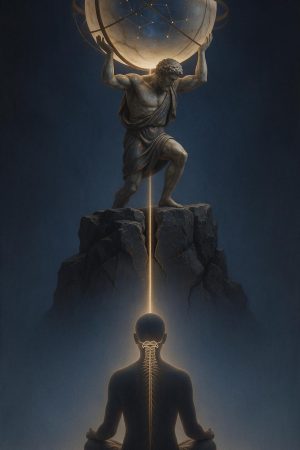
Atlas is usually remembered as the figure who bears the world on his shoulders. That familiar image is not quite the older Greek story: Atlas bears the heavens—the vault of sky—so that heaven and earth remain distinct. He is not only a sufferer under a burden. He is also a bearer of a necessary cosmic responsibility.
The first cervical vertebra, C1, is named for him. The atlas vertebra supports the skull at the top of the spine, forming the delicate structural threshold at which the head balances above the body. The connection is anatomical, but it also offers a powerful contemplative metaphor: the mythic Atlas bears the heavens; the bodily atlas bears the crown.
Atlas and the New Order
Atlas is a Titan, a member of the older generation of Greek divine powers. After the Titanomachy—the conflict in which Zeus and the Olympians establish a new cosmic order—Atlas is given the task of holding up the heavens.
This has often been read purely as a punishment: he opposed the new rulers, lost, and was condemned to endless labour. That element is certainly present in the myth. Yet it is not the only possible meaning.
Atlas is not annihilated or made irrelevant. His immense strength is given a new function. He becomes responsible for a foundational work: sustaining the separation between earth and sky, preserving the world’s structure, and bearing a weight that cannot be allowed to fall.
Seen in this way, his story can be read as a movement from resistance to responsibility.
-
The older order comes into conflict with the emerging order.
-
The conflict ends.
-
A former challenger is given a role proportionate to his power ability.
-
Strength once expressed through struggle becomes strength expressed through steadiness.
Atlas therefore represents more than suffering. He represents the difficult dignity of taking one’s place in a changed world. His burden remains a burden, but it is also a vocation.
The Atlas Vertebra: Bearing the Crown
The atlas is the first cervical vertebra, C1. It is the uppermost bone of the movable spine and supports the skull. Its special form allows the head to nod, balance, and transmit its weight into the neck and the rest of the spinal column.
The skeletal comparison with the Titan is immediate:
The head is often called the body’s crown. It carries the organs of sight, hearing, taste, speech, and much of the apparatus by which we orient ourselves in the world. It is also the ordinary location of thought: planning, self-description, memory, anticipation, judgement, and the sense of being a separate observer.
The atlas therefore occupies a small but symbolically potent place. It is a physical threshold at which the crown is not forced upward by muscular struggle, but permitted to balance on the central axis of the body.
Not Holding the Head Up
A common misunderstanding of upright posture is that it requires effortful correction: chest lifted, chin pulled in, head held high. This often produces precisely what contemplative traditions seek to soften—unnecessary tension in the jaw, throat, shoulders, and upper neck.
A subtler instruction appears in meditation practice: do not hold the head up. Let it balance.
The practical image is simple:
             ↑

crown

|
          [head]

|
           C1/C2

|
           spine

|
pelvis
             ↓

ground
The crown rises gently; the pelvis and seat are grounded. The spine lengthens between the two without rigidly forcing either direction. The chin neither juts forward nor is aggressively pinned back. The neck does not have to fight gravity because the head is allowed to find its pivot.
This is not a demand for perfect anatomical placement. Bodies vary, injuries occur, and a person should never force their neck into pain. The point is experiential rather than perfectionistic: reduce avoidable effort, find sustainable balance, and allow the posture to become stable enough that it no longer monopolizes attention.
Body, Breath, and Mind
Zen and yoga are distinct traditions with distinct histories, vocabularies, and aims. Yet both offer rich ways of understanding the interdependence of bodily organization, breathing, and attention.
In Zen practice, the seated body is not merely a container for meditation. Posture itself is part of the practice. A stable seat, an upright yet unstrained spine, and a naturally balanced head create the conditions in which breath may settle without being forced. As bodily agitation quiets, the mind is invited to become less reactive and less scattered.
In yogic language, a broad contemplative progression may be described as follows:
Balanced relationship with gravity
            ↓

Release of unnecessary muscular effort
            ↓

Stable, sustainable posture
            ↓

Natural or refined breathing
            ↓

Quieter sensory and mental reactivity
            ↓

Concentration
            ↓

Meditation

↓

Deepened awareness
The value of this sequence is not that it turns meditation into a mechanical formula. Stillness does not guarantee revelation, and no vertebra can manufacture wisdom. Its value is that it recognizes an ordinary but profound fact: when the body is continually bracing, guarding, or struggling for balance, attention is repeatedly pulled outward. When the body becomes sufficiently stable and the breath sufficiently unforced, attention may be freed to become more intimate, clear, and quiet.
Ājñā, Sahasrāra, and the Pineal Symbol
Esoteric language often associates the brow with the “third eye” and the crown with a more expansive or transcendent consciousness. In the chakra system, these are commonly named Ājñā and Sahasrāra.
The deeper structural resemblance lies elsewhere. Many contemplative systems move through a recognizable arc:
-
Establish a stable physical axis.
-
Refine or naturalize the breath.
-
Withdraw from compulsive sensory and mental distraction.
-
Develop concentration.
-
Deepen into meditation.
-
Become available to a mode of awareness not dominated by ordinary reactivity.
The atlas belongs to the first part of this arc. It is not the cause of higher consciousness. It symbolizes the point at which the head—thought, perception, and the bodily crown—can rest in relationship to the central axis rather than being continually held by strain.
The Atlas as a Contemplative Threshold
The Titan holds the heavens. The atlas vertebra bears the skull. The meditator learns to let the crown balance above a grounded body.
These are not equivalent claims; one is myth, one is anatomy, and one is a practice of attention. But together they make a coherent symbolic field.
-
The earthward pole is the pelvis, seat, legs, and ground: embodiment, gravity, daily life, relationship, and responsibility.
-
The central axis is the spine: continuity, presence, and the capacity to remain with experience.
-
The upper pivot is C1/C2: the subtle place where head and body meet without excess effort.
-
The brow is inner vision: the capacity to see thoughts, images, and impulses rather than merely being swept away by them.
-
The crown is openness: the possibility of awareness not contracted around self-protection or control.
A person does not need to escape the earthward pole to become “spiritual.” In this image, true openness depends upon grounding. The crown rises not because the body is rejected, but because the body is sufficiently balanced to stop demanding constant correction.
From Punishment to Vocation
The myth becomes especially helpful when Atlas is understood not only as punished but as entrusted with a new role under a changed order.
In ordinary life, a person may resist a transition: a loss, an ending, a new responsibility, a changed identity, a truth they did not choose. The initial experience can feel like Atlas’s burden—too heavy, imposed, and endless. Yet over time, the same burden may become a vocation: a place where strength finds a truer expression.
Contemplative practice does not remove every burden. It changes the manner in which one meets it. Instead of using force to hold the self together, one learns balance. Instead of fighting gravity, one cooperates with it. Instead of seeking a dramatic escape from the world, one learns to inhabit a stable relation between earth and sky.
That is Atlas’s wisdom in bodily form:
The task is not to become weightless. The task is to become poised enough to carry what matters without collapsing into strain.
A Practice Image
For a brief seated reflection, begin gently and without trying to adjust the neck into an idealized position.
-
Sit in a stable, comfortable way, with support if you need it.
-
Feel the downward contact of the body with chair, cushion, or ground.
-
Let the spine lengthen naturally rather than rigidly.
-
Imagine the crown lightly rising, as if it were being given space from above.
-
Allow the chin and throat to soften instead of pushing the head backward.
-
Sense the head balancing above the upper neck, rather than being held up by effort.
-
Let the breath be received rather than manufactured.
-
Notice thoughts without trying to solve them, suppress them, or turn them into a special experience.
The image is not “I must hold up the heavens.” It is “I can meet the heavens with a balanced body.”
Conclusion
Atlas the Titan, the atlas vertebra, and the contemplative crown all speak to a single human question: how do we carry immense weight without becoming defined by strain?
Myth answers through an image of cosmic responsibility. Anatomy answers through a small, specialized bone at the top of the spine. Contemplative practice answers through poise: a grounded seat, a balanced head, a freer breath, and an awareness that no longer needs to force itself upward.
The Titan’s burden need not be read only as punishment. It can also be read as the transformation of power into service. Likewise, the atlas vertebra is not a mystical switch or a promise of altered states. It is a humble physical reminder that the crown is best supported not through domination of the body, but through relationship—between head and spine, effort and release, earth and sky.
In that sense, Atlas becomes a metaphor for higher consciousness not because he escapes the world, but because he learns to bear its vastness.
Greek Mythology
-
Hesiod. Theogony, lines 517–520 and 746–748. In the key classical passage, Atlas stands at the world’s boundary and “upholds the wide heaven” with head and hands. This supports the important correction that he bears the sky/heavens, not originally the Earth. Perseus Digital Library.perseus.tufts
-
Apollodorus. The Library, Book 2, especially the Heracles/Golden Apples episode. Useful for the later mythic development in which Heracles temporarily takes Atlas’s burden while Atlas seeks the apples of the Hesperides.
-
Homer. Odyssey, Book 1, lines 52–54. An early depiction of Atlas connected with the “long pillars” that hold apart heaven and earth; valuable because it shows that Atlas’s cosmic role had more than one ancient formulation.
-
Graves, Robert. The Greek Myths. Penguin. A readable modern retelling, useful for narrative context but best cited alongside—not instead of—Hesiod, Homer, and Apollodorus.
-
Hard, Robin, trans. The Routledge Handbook of Greek Mythology: Based on H. J. Rose’s Handbook of Greek Mythology. Routledge. A strong modern scholarly guide to variants of the Atlas tradition and its place in Greek myth.
Zen and Posture
-
Dōgen. Fukan Zazengi (“Universal Recommendation for Zazen”). In The Heart of Dōgen’s Shōbōgenzō, translated by Norman Waddell and Masao Abe, SUNY Press. A foundational Sōtō Zen text for understanding seated practice as an integrated practice of body, breath, and mind—not simply preparation for meditation.
-
Sōtō Zen International. “How to Do Zazen.” Official Sōtō Zen guidance: straighten the spine, draw in the chin, lengthen the neck “as though reaching toward the ceiling,” then relax the shoulders, back, and abdomen without abandoning upright posture. SOTOZEN.sotozen
-
Sōtō Zen. The Practice of Zazen. Practice leaflet. Particularly useful for the concrete posture language used in the article: ears aligned with shoulders, nose aligned with navel, upright without leaning forward, backward, or to either side. SOTOZEN PDF.sotozen
-
“Dharma Eye,” Issue 55. Sōtō Zen publication. Discusses the head’s centre of gravity as lying in front of the cranial pivot at the top of the cervical spine, with the practical instruction to balance rather than stiffly hold the head. This is especially relevant to the article’s phrase, “Do not hold your head up; let it balance.”sotozen
-
Suzuki, Shunryu. Zen Mind, Beginner’s Mind. Weatherhill. A concise and influential modern Zen source on zazen, non-striving, posture, breath, and the ordinary discipline of sitting.
Yoga and Consciousness
-
Patañjali. Yoga Sūtras, especially 2.29, 2.46–2.49, and 2.54–2.55. These passages establish the eight limbs of yoga: ethical observances, posture (āsana), breath regulation (prāṇāyāma), sense withdrawal (pratyāhāra), concentration (dhāraṇā), meditation (dhyāna), and absorption (samādhi).satyori
-
Patañjali. The Yoga Sūtras of Patañjali, translated by Edwin F. Bryant. North Point Press, 2009. A widely respected modern translation and commentary, useful for a serious account of posture, breath, sensory withdrawal, concentration, meditation, and samādhi.
-
Patañjali. The Yoga Sutras of Patanjali, translated by Swami Satchidananda. Integral Yoga Publications. Accessible for general readers, particularly on the formulation of āsana as a steady, comfortable posture and the sequential relationship between posture and breath work.
-
Feuerstein, Georg. The Yoga Tradition: Its History, Literature, Philosophy and Practice. Hohm Press. A substantial reference for distinguishing classical yoga systems from later tantric, occult, and modern esoteric syntheses.
-
Mallinson, James, and Mark Singleton. Roots of Yoga. Penguin Classics, 2017. An excellent scholarly source for the diversity of premodern yoga traditions and for avoiding an overly simplified account of a single, timeless yogic system.
Chakras and the Pineal Symbol
-
White, David Gordon, ed. Tantra in Practice. Princeton University Press. A strong academic introduction to tantric traditions, useful for contextualizing chakras without projecting modern New Age correspondences backward onto all historical Indian traditions.
-
Flood, Gavin. The Tantric Body: The Secret Tradition of Hindu Religion. I.B. Tauris. Explores the subtle body, channels, energies, and ritual imagination in South Asian traditions with more historical care than popular chakra accounts.
-
Avalon, Arthur (Sir John Woodroffe), trans. The Serpent Power: The Secrets of Tantric and Shaktic Yoga. Dover Publications. Historically influential in introducing chakra concepts to English-speaking esoteric audiences. Use critically: it is important for understanding the modern Western reception of chakras, but it should not be treated as the sole or neutral account of Indian traditions.
-
Hanegraaff, Wouter J. New Age Religion and Western Culture: Esotericism in the Mirror of Secular Thought. SUNY Press. Useful for explaining why modern esotericism often merges anatomical language, chakras, pineal symbolism, altered states, and spiritual development.
-
Joseph, Robert, et al. “The Pineal Gland: A Review of Its Role in Consciousness and Mental Health.” This type of modern pineal literature may be relevant if you discuss its physiological role, but it should be clearly distinguished from the historical meanings of Ājñā and Sahasrāra.
Anatomy and Physiology
-
OpenStax. Anatomy and Physiology 2e, “The Vertebral Column.” A clear, freely available overview: the first cervical vertebra is the atlas; the vertebral column begins development as 33 vertebrae, later incorporating fused sacral and coccygeal segments. OpenStax.openstax
-
StatPearls. “Anatomy, Head and Neck: Cervical Vertebrae.” National Center for Biotechnology Information. A clinical anatomy reference for C1, C2, and the cervical spine. NCBI Bookshelf.ncbi.nlm.nih
-
StatPearls. “Anatomy, Head and Neck: Atlantoaxial Joint.” National Center for Biotechnology Information. Useful for the relation between the atlas (C1), axis (C2), and head rotation. NCBI Bookshelf.ncbi.nlm.nih
-
Egermann, Marcus, et al. “Pinealectomy Affects Bone Mineral Density and Structure: An Experimental Study in Sheep.” BMC Musculoskeletal Disorders 12 (2011): 271. Useful only for the limited claim that pineal-related signalling and melatonin may influence bone metabolism in an animal model—not for a claim that C1 alignment controls pineal output or bone healing. PMC full text.pmc.ncbi.nlm.nih
-
Tan, Dun-Xian, et al. “Pineal Calcification, Melatonin Production, Aging, Associated Health Consequences and Rejuvenation of the Pineal Gland.” Molecules 23, no. 2 (2018): 301. Useful for basic context regarding melatonin and pineal physiology, while avoiding claims that the pineal gland is anatomically identical to the yogic “third eye.” PMC full text.pmc.ncbi.nlm.nih