Sacrifice and Responsibility: From Scapegoats to Free Will
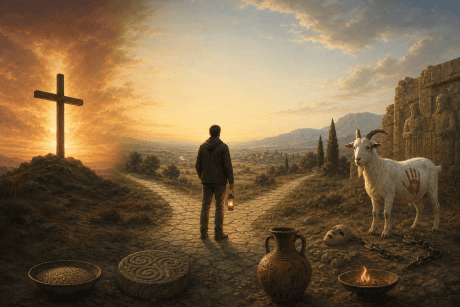 For thousands of years, people have made sacrifices to gods, ancestors, rulers, nations, families, and ideals. They have offered grain, animals, wealth, labour, time, obedience, and sometimes human lives. These acts were not always understood in the same way: they could sustain the natural order, honour the dead, seek protection, heal a breach, bind a community together, remove guilt, or secure favour from unseen powers.
As human religious, moral, and economic understanding changed, so did the meaning of sacrifice. What begins as an offering made at a shrine or altar gradually becomes connected with duty, sin, purification, redemption, scapegoating, spiritual debt, personal discipline, and material exchange. The central question changes from what must we give to the gods? to what must we give up in order to live rightly—and what will that choice cost or make possible for others?
This article traces that evolution: from prehistoric offerings and the temple cultures of Babylon, Egypt, Persia, India, China, Greece, Celtic Britain, and Anglo-Saxon England; through Jewish ideas of sin and the scapegoat; to the Christian interpretation of Yeshua’s death, medieval indulgences, and modern secular ideas of sacrifice.
Today, sacrifice usually means something quieter but no less real. We are all making sacrifices whenever we choose one action over all the other actions we might have taken. The quality of that sacrifice depends on our ability—through free will, or at least the experience of having it—to judge the best possible decision, and then follow through.
A good sacrifice gives up something immediate for something more enduring: it builds character and, ideally, improves prosperity for oneself, one’s community, and one’s environment. A poorer sacrifice is short-sighted. It seeks a quick advantage, creates a deficit elsewhere, and acts to the detriment of character, community, or the world that sustains us.
What sacrifice can mean
The word “sacrifice” gathers together practices that are not identical. Ancient peoples could make offerings for very different purposes:
- Gift and reciprocity: giving something valuable to a god, ancestor, spirit, or sacred place, in expectation of protection, prosperity, or continuing favour.
- Communion: sharing food in a rite that joins people to one another, to their ancestors, or to divine powers.
- Cosmic maintenance: helping sustain the balance of nature, kingship, fertility, seasons, and the wider order.
- Purification: removing illness, taboo, pollution, misfortune, or ritual disorder.
- Reparation: making good a breach caused by an offence, broken oath, or neglected duty.
- Representation: a king, priest, animal, object, or ritual victim acts on behalf of a family, tribe, city, or nation.
- Scapegoating: placing collective fear, guilt, or disorder onto a person, animal, or group, then expelling, abandoning, or destroying it.
- Renunciation: giving up an immediate desire or advantage in pursuit of a deeper aim.
These meanings often overlap. A bull offered at a sanctuary might be a gift to a god, a public display of wealth, a feast for the community, and a request for fertility or protection at the same time.
Ancient sacrificial worlds
| Culture or setting | Forms of sacrifice | Main purposes and meanings |
|---|---|---|
| Prehistoric and Neolithic societies | Food, animals, tools, valuables, structured deposits, funerary gifts; in some locations, possible human offerings | Ancestors, fertility, territory, seasonal renewal, communal identity, and relations with the dead |
| Mesopotamia and Babylon | Food, drink, incense, animals, textiles, temple goods | Maintaining the gods’ temples and the ordered life of city, king, harvest, and family |
| Ancient Egypt | Temple food, drink, incense, votives, animals, offerings to the dead | Sustaining ma’at: truth, justice, balance, right order, and the relationship between gods, ruler, land, and dead |
| Ancient Iran and Persia | Haoma rites, fire ritual, prayer, milk, water, bread and, in older traditions, animal offerings | Purification, right order, communion with divine reality, strength, victory, and alignment with truth against destructive disorder |
| Vedic India | Fire offerings of ghee, grain, milk, soma, and sometimes animals | Supporting ṛta, the proper cosmic order; seeking rain, health, prosperity, fertility, and victory |
| Later Indian traditions | Food offerings, flowers, lamps, fasting, vows, pilgrimage, devotional service; animal sacrifice in certain regional traditions | Devotion, blessing, divine presence, protection, transformation, and the offering of action itself |
| Ancient China | Offerings to ancestors, Heaven, local powers, and imperial rites: animals, food, wine, jade, ritual goods | Maintaining lineage, filial duty, dynastic legitimacy, and harmony between Heaven, ancestors, ruler, and people |
| Ancient Greece | Animal sacrifice, libations, first fruits, votives, festivals, shared meals | Honouring gods, creating civic unity, seeking favour, and marking the rhythm of communal life |
| Rome | Public animal offerings, vows, libations, household rites, state cult | Preserving pax deorum: a proper and peaceful relationship between Rome and its gods |
| Celtic and Druidic worlds | Animal offerings, deposits of weapons and valuables, feasting, springs and sacred places; possible human offerings in rare contexts | Vows, healing, warfare, status, seasonal ritual, relations with land and divine powers |
| Anglo-Saxon England | Animals in cremation rites and graves, food and drink offerings, foundation deposits, feasting, votives | Honouring the dead, status and kinship, transformation through cremation, place-making, and relations with unseen powers |
| Ancient Israel and Judaism | Thanksgiving, communal offerings, purification, reparation, festival rites, Day of Atonement | Covenant, worship, purification, restoring damaged relations, and ordering the community before God |
Before temples: sacrifice in prehistory
Before written records, we cannot know precisely what people believed when they placed objects with the dead, deposited tools or animal bones in special places, or built monuments aligned with landscape and sky. Archaeology can show patterned behaviour; it cannot read prayers.
Nevertheless, Palaeolithic graves, red ochre burials, animal remains, ritual deposits, and later Neolithic monuments show that people marked death and place with more than practical concern. As farming and herding developed, the annual dependence on soil, weather, animals, fertility, and stored food became increasingly obvious. To offer part of a crop, herd, or harvest was to give away something on which survival depended.
This may be the oldest sacrificial logic: a portion is surrendered to acknowledge that life depends on powers beyond individual control.
Superstition can develop when people assert that they know the nature, motives, and demands of that power—whether it is understood as God, nature, fate, ancestors, spirits, or some other being.
Mesopotamia and Babylon
In Mesopotamian religion, sacrifice often centred on the temple as the god’s dwelling and service-house. Gods received bread, beer, wine, incense, animals, garments, music, and regular ritual attention. The city maintained the god; in return, the god protected city, king, harvest, and order.
This was not primarily a system in which individuals transferred their sins onto victims. It was closer to a sacred economy of obligation and reciprocity. Neglecting the gods, breaking oaths, ignoring omens, or failing in ritual duty could bring danger, while proper offerings sustained the relationship between humanity and the divine world.
Egypt: sacrifice and ma’at
Egyptian religion placed ma’at at its centre: truth, justice, balance, proper measure, and the order that keeps chaos at bay. Temple offerings fed and honoured the gods, while offerings to the dead maintained continuity between the living and their ancestors.
The king’s ritual role was especially important. His duty was not merely personal devotion but the maintenance of right order across the land. Sacrifice therefore linked divine favour, ethical order, political legitimacy, the Nile’s fertility, and the stability of the kingdom.
Rather than a single theory of guilt and payment, Egypt presents sacrifice as part of a civilisation-wide effort to keep the world aligned with truth and balance.
Iran and Persia: sacrifice, truth, and sacred order
Ancient Iranian religion shares roots with the Vedic world but developed its own distinctive emphasis on truth, purity, and the struggle between constructive and destructive forces. In Zoroastrian tradition, the central opposition is often expressed as asha—truth, right order, and reality—against druj, deceit, disorder, and corruption.
The Yasna ceremony, involving sacred recitation, fire, water, milk, and the preparation of haoma, is one of the great Iranian ritual forms. Haoma is both a sacred plant and a divine being in the tradition; its pressed juice is consecrated and used in ritual. Older Iranian materials also preserve animal-sacrifice elements, including designated portions given within the rite. iranicaonline
The direction of Zoroastrian religious thought is significant: ritual is linked not merely to bargaining for favour but to choosing truth in thought, word, and deed. Sacrifice becomes part of an ethical cosmology in which human action helps strengthen order against deceit and destruction.
India: from outward offering to inward discipline
Vedic sacrifice, yajña, was among the most elaborate ritual systems of the ancient world. Priests offered ghee, grain, milk, soma, and sometimes animals into fire, which carried the offering to the devas. The rite sought to sustain ṛta: cosmic order, the regularity of seasons, rain, fertility, health, and prosperity.
Over centuries, Indian traditions reworked sacrifice in striking ways. The Upanishads increasingly turned attention inward: breath, knowledge, meditation, discipline, and self-understanding could become the deeper offering. Buddhist and Jain traditions challenged the authority of Vedic sacrifice and placed non-harm, liberation, and ethical transformation at the centre of the religious life.
Later Hindu traditions retained offering in many forms—food, flowers, lamps, water, fasting, vows, pilgrimage, service, and devotion. The object sacrificed increasingly became not merely an animal or material possession but pride, attachment, ignorance, desire, and self-centred action.
China: ancestors, Heaven, and the state
Ancient Chinese sacrifice linked the family, the ancestors, the ruler, and Heaven. Food, wine, animals, jade, and ritual goods were offered in ancestral rites and state ceremonies. The point was continuity: the dead remained part of the moral and political life of the living.
The emperor’s role was especially weighty. He ruled under the Mandate of Heaven, and his ritual responsibilities expressed the health of the relationship between Heaven and the human world. Failed governance, famine, disorder, or catastrophe could be interpreted as signs that harmony had broken down.
Sacrifice in this setting was neither mainly about personal guilt nor individual salvation. It was a discipline of relationship: family to ancestor, ruler to Heaven, and society to the natural and moral order.
Greece and Rome: sacrifice as public bond
Greek sacrifice commonly joined worship and feasting. An animal was killed ritually, portions were allotted to the gods, and the community ate the remaining meat. This was not simply “giving something away”; it made the city visible as a shared body under divine protection.
Roman religion developed a related public logic. Sacrifice, vows, festivals, and priestly offices helped preserve pax deorum: the properly maintained peace between Rome and its gods. Ritual failure was not just a private spiritual concern; it could threaten the welfare of the state.
In both worlds, sacrifice worked as a public language of duty, civic membership, gratitude, hierarchy, and mutual obligation.
Celtic and Druidic sacrifice
The Druids were learned ritual specialists in parts of Iron Age Gaul and Britain, known to us mainly through Greek and Roman writers, later Irish and Welsh literature, and archaeology. They appear to have been connected with teaching, law, memory, divination, ritual, and the management of sacred obligations.
Animal offering is far better supported than lurid popular images of mass human sacrifice. Across Celtic and Romano-British settings, archaeologists find animal remains, structured deposits, weapons, coins, and other valuable objects at sanctuaries, rivers, springs, pits, and ceremonial sites. Bulls and cattle were especially powerful animals: they represented wealth, herd fertility, strength, prestige, agricultural productivity, and martial force.
A bull sacrifice could therefore speak at several levels. It was a costly offering because cattle were economically valuable; it could honour a deity, seal a vow, mark a seasonal gathering, seek health or victory, and provide meat for ceremonial feasting. The animal’s blood, hide, skull, horns, and selected bones could carry special ritual weight, while the shared meal bound a community together.
The archaeological picture is necessarily incomplete, but sacrifice in Celtic worlds appears to have been less about a single doctrine and more about relationships among people, animals, land, status, the ancestors, and the sacred powers of particular places. Animals were central to ritual activity at religious sites in Britannia through sacrifice, votive deposition, divination, imagery, and feasting. traj.openlibhums
Anglo-Saxon sacrifice and the dead
Pre-Christian Anglo-Saxon religion is reconstructed largely from burial archaeology, place names, later written references, and comparison with wider Germanic traditions. Graves, cremations, animal remains, weapons, jewellery, food deposits, and ritual landscapes indicate that death was treated as a transformation requiring careful ceremony.
At Spong Hill in Norfolk, animal remains appeared in nearly half of cremation burials; horses and sheep or goats were particularly common. Elsewhere, cattle skull deposits, animal bones near ritual sites, and animal-associated burials suggest feasting, offering, status display, and rites connected with the dead. academic.oup
The animal could accompany the dead, provide a symbolic resource for the journey beyond death, express rank and kinship, or embody a gift linking the living community with ancestral and unseen worlds. Sacrifice here was not necessarily an offering to erase moral guilt. It was an act of continuity: the dead person, their household, their animals, and their community remained bound together through ritual.
Israel, sin, and the scapegoat
Ancient Israelite sacrifice introduced a set of concepts that would later shape Judaism, Christianity, and Western moral imagination. Yet the system was never only about sin. It included thanksgiving, communal meals, first fruits, purification, festival worship, vows, and reparation for particular harms.
The Day of Atonement, described in Leviticus 16, is especially important. Two goats are selected. One is used in a ritual offering; over the other, the high priest confesses the sins of the people before it is sent away into the wilderness. The second animal becomes the origin of the later English term scapegoat.
The ritual dramatises the removal of communal disorder. It does not simply say that a criminal’s punishment has been transferred to an innocent victim. But it created a powerful pattern: guilt can be named, placed somewhere, and carried away.
That pattern has a dark social afterlife. Communities in crisis often locate blame in an outsider, minority, stranger, prisoner, alleged witch, political dissident, or defeated enemy. The victim becomes a human scapegoat: burdened with a society’s fear and failures so that others may imagine themselves cleansed.
Yeshua and the Christian reinterpretation
The first followers of Yeshua interpreted his Roman execution through Jewish patterns already available to them: Passover, sacrifice, covenant, ransom, righteous suffering, forgiveness, purification, and the defeat of death.
Paul’s phrase, “Christ died for our sins,” became one of Christianity’s shortest summaries of this belief. But the phrase did not produce only one explanation. Across Christian history, the cross has been understood as:
- Sacrifice: a decisive act of cleansing and reconciliation.
- Ransom: liberation from captivity to sin, death, or hostile spiritual powers.
- Christus Victor: the defeat of sin, death, violence, and evil through cross and resurrection.
- Moral example: a revelation of radical love that exposes violence and calls people into repentance and transformation.
- Satisfaction: Christ’s faithful obedience repairs a breach in the moral order.
- Penal substitution: Christ bears the punishment deserved by sinners.
The last model is now often assumed whenever someone says “Jesus died for your sins.” Historically, however, it is one interpretation among several. Earlier Christian thought often placed greater stress on liberation, victory, healing, participation, and transformation; medieval theology developed satisfaction language; Reformation traditions gave particular force to legal and penal imagery. uwaterloo
Indulgences: sacrifice as debt and release
In medieval western Christianity, sacrifice increasingly appeared in the language of spiritual debt. Sin was understood to have two consequences: guilt before God, and damage or “temporal punishment” resulting from the disorder caused by sin.
In simple terms, confession and repentance were believed to restore the sinner to God; an indulgence was said to reduce the remaining penance or purification still required. It was not officially meant to be permission to sin, nor the purchase of forgiveness itself.
In practice, indulgences became tied to fundraising, pilgrimage, charitable gifts, political power, and anxiety about purgatory. Their abuse helped provoke Martin Luther’s protest in 1517. The shift is revealing: sacrifice had moved far from altar and animal into penance, prayer, charity, pilgrimage, institutional authority, and spiritual accounting.
Sacrifice today
 In modern speech, sacrifice rarely means blood ritual. It means deliberately giving up one possible gain in order to pursue another:
- A parent gives time, sleep, money, and freedom for a child.
- An artist gives comfort and certainty for craft.
- A person gives immediate pleasure for health, learning, or mastery.
- A citizen gives time, resources, or convenience for a community.
- A society accepts limits now to preserve land, water, climate, and future prosperity.
Every choice has a sacrificial structure. To choose one path is to surrender alternatives. The quality of a sacrifice lies in how well a person uses that unavoidable loss: whether they can judge what matters most, accept the cost, and follow through.
Free will may be complete, partial, conditioned, or even illusory; in ordinary life, we still experience ourselves as choosing. Character is formed in those choices. A person who repeatedly gives up short-term appetite for a larger purpose may gain discipline, skill, trust, prosperity, and a better relation with community and environment. A person who repeatedly sacrifices the long term for immediate appetite may create a deficit—in their own character, their relationships, and the world around them.
The danger in redemptive victimhood
The idea that an innocent person’s suffering can save others has great emotional and cultural power. It can be interpreted as love, courage, solidarity, and voluntary self-giving. But when adopted carelessly, it can also provide a language through which people excuse harm or avoid responsibility.
It can teach that:
- Suffering is automatically sacred or spiritually desirable.
- Victims should endure abuse rather than resist or escape it.
- Wrongdoers need not make repair because someone else has “paid.”
- A community can preserve itself by loading its guilt onto a vulnerable person or group.
- Leaders can demand sacrifice from others while protecting their own interests.
- Self-interest can disguise itself as duty, holiness, patriotism, or necessity.
The distinction is between chosen sacrifice and imposed victimhood. A person who freely gives something of themselves for a genuinely greater good makes one kind of sacrifice. A community that forces the weak to carry its failures is making another.
Conclusion: sacrifice and the use of freedom
The history of sacrifice moves from gifts at graves and offerings at shrines to fire rites, temple animals, ancestral meals, kingship, purification, scapegoats, penance, martyrdom, and everyday self-denial. Its forms have changed, but the underlying question remains: what should be given up, and for what end?
Every human life is shaped by sacrifice because every meaningful act excludes other possible acts. We surrender time to work rather than leisure, comfort to achievement, immediate appetite to health, private advantage to loyalty, and certainty to creation. The central issue is not whether we sacrifice, but whether we sacrifice well.
A worthwhile sacrifice is one made with sufficient awareness of its cost and its consequences: a choice that strengthens character, increases real prosperity, protects one’s community, and improves one’s relationship with the living world. A poorer sacrifice is short-sighted. It pursues immediate gain while weakening the person, the community, or the environment that makes future life possible.
Ancient religions made sacrifice visible in blood, grain, fire, and ritual. Modern life hides it inside decisions. But the old questions remain: what are we willing to give, what are we really gaining, and who ultimately bears the cost? And when a cost is rightly due, what further cost follows when we refuse to bear it—passing it instead onto the other (human, divine goats!), the future, or the world around us?
Core references
- Encyclopaedia Britannica, “Sacrifice” — broad introduction to sacrifice as an offering intended to establish, maintain, or restore a right relationship with the sacred. britannica
- Encyclopaedia Britannica, “Sacrifice in the Religions of the World” — useful comparative overview, particularly for Vedic and Hindu traditions. britannica
- Encyclopaedia Britannica, “Blood Offerings” — animal and human sacrifice, blood as sacred life-force, fertility, purification, and expiation. britannica
- Encyclopaedia Britannica, “Prehistoric Religion: Sacrifices” — cautious discussion of possible offerings to the dead from the Middle Palaeolithic onward. britannica
- Oxford Handbook of the Archaeology of Ritual and Religion, “Sacrifice” — archaeological approaches to sacrifice across cultures and periods. academic.oup
Iran and Persia
- Encyclopaedia Iranica, “Yasna” — central Zoroastrian ritual; its Indo-Iranian roots, haoma, older animal-sacrifice elements, bread offering, and cosmic purpose. iranicaonline
- Encyclopaedia Iranica, “Haoma II: The Rituals” — detailed explanation of haoma preparation within the Yasna, Visperad, and Vendidad rites. iranicaonline
- University of Texas Linguistics Research Center, “Young Avestan: Yasna 10—Hymn to Haoma” — a translated primary-text excerpt on Haoma. lrc.la.utexas
- Encyclopaedia Britannica, “Yasna” — short accessible overview of the Zoroastrian rite, sacred fire, haoma, bread, milk, and earlier meat/fat offerings. britannica
Druids, Celts, and Britain
- Julius Caesar, The Gallic War, Book 6, sections 13–18 — primary Roman source for Druids, their social role, ritual authority, and claims about sacrifice. Use critically: Caesar was writing as a Roman general during conquest.
- National Geographic, “Druids Committed Human Sacrifice, Cannibalism?” — overview of claims, archaeological finds, and the continuing controversy around interpreting them. nationalgeographic
- University of Wales Trinity Saint David, “Did the Ancient Celts Practise Human Sacrifice?” — useful corrective source arguing that material evidence for the broad claims is limited and contested. repository.uwtsd.ac
- Theoretical Roman Archaeology Journal, “Animal Offerings in Ritual, Economic and Social Contexts in Britannia” — strong source for animal sacrifice, structured deposition, feasting, and ritual use of animals in Roman Britain. traj.openlibhums
- Cambridge University, “The Suppression of the Druids in Caesar’s Gallic War” — useful for Caesar’s political and literary treatment of Druids. camws
Anglo-Saxon England
- Oxford Handbook of the Archaeology of Ritual and Religion, “Pre-Christian Practices in the Anglo-Saxon World” — scholarly overview of Anglo-Saxon ritual and religious practice. academic.oup
- UCL, Pre-Christian Anglo-Saxon Worship: A Semantic Study — detailed research on Anglo-Saxon and continental Germanic cult, ritual sites, and sacrifice. discovery.ucl.ac
- University of Reading, The Zooarchaeology of the Anglo-Saxon Christian Conversion — includes discussion of the cattle-skull deposit at Yeavering and animal remains in ritual contexts. centaur.reading.ac
- Taylor & Francis, “An Ideology of Transformation: Cremation Rites and Animal Sacrifice in Early Anglo-Saxon England” — useful for animal sacrifice, cremation, and ritual transformation. taylorfrancis
Israel, scapegoats, and atonement
- Leviticus 16, NRSVUE — the primary text for the Day of Atonement and the goat sent into the wilderness.
- Isaiah 52:13–53:12, NRSVUE — the “suffering servant” passage central to later Christian readings of vicarious suffering and sin-bearing.
- 1 Corinthians 15:3–8, NRSVUE — Paul’s concise formulation: Christ “died for our sins … was buried … [and] was raised.”
- Oxford University Press, The Suffering Servant: Isaiah 53 in Jewish and Christian Sources — review of a major scholarly collection on Jewish and Christian readings of Isaiah 53. academic.oup
- Jews for Judaism, “Did Jews Believe the Suffering Servant Was the Messiah?” — a Jewish counter-reading of claims that Isaiah 53 was widely understood before Christianity as a prophecy of an atoning Messiah. jewsforjudaism
Christian atonement and indulgences
- Conrad Grebel Review, “Atonement Models and the Christian Tradition” — useful overview of recapitulation, ransom, satisfaction, moral influence, and later atonement theories. uwaterloo
- Calvin Theological Journal, “Christ’s Atonement: A Multi-Dimensional Approach” — discusses major clusters: ransom/victory, sacrifice, substitution, and related models. calvin
- Stanford Encyclopedia of Philosophy, “Atonement” — a strong philosophical reference for satisfaction, substitution, moral influence, reconciliation, and criticisms of atonement models.
- Encyclopaedia Britannica, “Indulgence” — concise explanation of indulgences, temporal punishment, medieval practice, and the Reformation controversy.
- Martin Luther, Ninety-Five Theses — primary source for the 1517 challenge to indulgence preaching and abuse.
Choice, responsibility, and scapegoating
- René Girard, Violence and the Sacred (1972) — influential theory of sacrifice, communal violence, and the scapegoat mechanism. It is interpretive theory rather than a settled account of all ancient sacrifice.
- René Girard, The Scapegoat (1982) — develops the argument that communities often transfer internal conflict onto a victim whose exclusion or destruction restores temporary unity.
- Stanford Encyclopedia of Philosophy, “Free Will” — useful background for the article’s closing reflections on freedom, conditioned choice, responsibility, and consequence.
- Stanford Encyclopedia of Philosophy, “Moral Responsibility” — useful for distinguishing choice, accountability, blame, character, and the conditions under which responsibility can be assigned.