Living Waters Is Moving Water
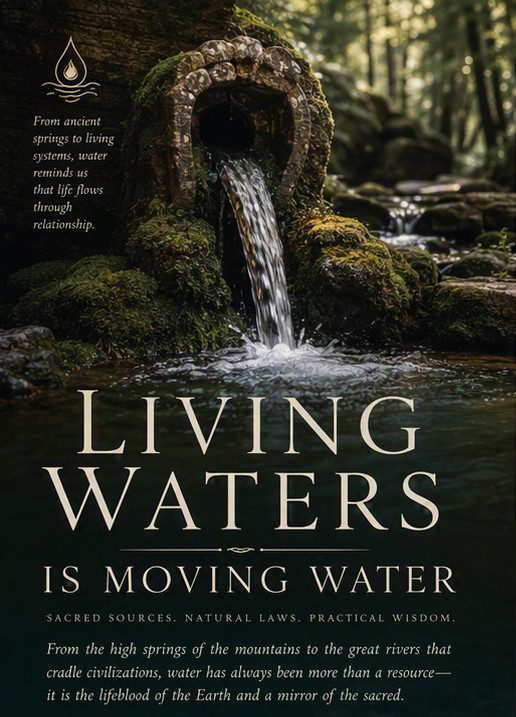 My personal journey with water began over 5 years ago with the discovery of a publicly available flowing spring near to where I live.
I already knew that water was sacred to people across time and across cultures: central to baptism and purification; associated with gods, goddesses and sacred wells; imagined as the primordial substance of creation; and recognised, above all, as the source of life itself. Yet encountering a living spring made that knowledge immediate.
For most of human history, water was not obtained by casually turning a tap. It had to be found, approached, carried and conserved—often over considerable distances. A full vessel was heavy, necessary and precious. Gold and diamonds may have signified wealth, but water was the treasure on which life depended.
Today, in much of the industrialised world, water arrives at the twist of the wrist. This is a profound convenience. But in gaining that convenience, have we lost something of our relationship with water?
Water, consciousness and technology
 Questioning our relationship to nature and water is not a modern concern. Thousands of years ago, following the invention of the water wheel, the Babylonians were early adopters of technologies that could lift and distribute water, saving many hours of human labour each year.
Their sister civilisation, Egypt, took a more cautious path. For the Egyptians, the Nile was not merely a resource to be managed, but a sacred presence at the centre of life, agriculture, ritual and cosmic order. There was a concern that processing water through mechanised means would change not only the work involved, but their relationship to water itself—and, with it, the state of human consciousness.
This tension between efficiency and reverence remains with us today. Modern systems give us extraordinary convenience, but they can also conceal the source, journey and nature of the water upon which we depend.
In more recent times following the industrial revolution, Viktor Schauberger gave this concern a distinctive voice. Through years of close observation of mountain springs, forest streams, rivers, trout and natural vortices, he showed us we had forsaken a deeper understanding and appreciation of water. We had learned how to capture, pump, heat, straighten and distribute it, but had lost touch with the natural principles through which water cools, circulates, carries life and renews itself.
Straight pipes, pumps, heat, concrete channels and industrial treatment reflected, in his view, a wider habit of forcing nature into forms that suited machinery rather than life. Schauberger invited us instead to look again at the mountain spring, the shaded forest stream, the trout in cold flowing water, and the spiral movements through which nature continually renews itself.
Water as a living element
 Schauberger used expressions such as living water, mature water and noble water. The modern phrase “structured water” is often associated with his work, although it is not quite his original language.
Water is never entirely passive. It gathers minerals from rock and soil. It responds to gravity. It forms springs, streams, rivers, clouds and rain. It changes with temperature, pressure, air, light, surfaces and the substances dissolved within it.
Even modern science describes water not as a static substance, but as a dynamic hydrogen-bond network—an ever-changing web of molecular relationships influenced by minerals, temperature, gases, pressure, surfaces and movement.
For Schauberger, this was not primarily a laboratory question. It was a lesson in observation. A living river is not a pipe. It is a moving relationship between water, gravity, landscape, air, light, trees, stone and life.
Flow matters in practical as well as symbolic ways. Moving water mixes, exchanges gases with air, responds to temperature, carries minerals, shapes its channel and resists the stillness associated with stagnation. In the home, we cannot recreate a mountain spring, but we can take lessons from it: coolness, gentle circulation, mineral balance, protection from excessive heat and light, and storage in materials and forms that respect water’s character.
The practical meaning of flow
For Schauberger, this continual movement is part of water’s natural renewal.
Aeration
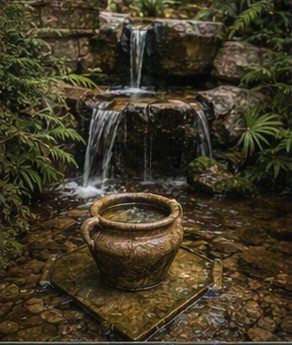
As water falls, tumbles or passes over stone, it meets air. This process is known as aeration. It allows gases to exchange between water and atmosphere, can reduce unpleasant volatile odours, and can make water feel fresher on the palate.
In conventional water treatment, aeration is used to remove gases such as hydrogen sulphide and methane, reduce excess carbon dioxide, and assist in the later removal of iron and manganese.
At home, water can be gently aerated by pouring it between two clean glass vessels, allowing it to flow through a glass funnel, or creating a short vortex in a carafe.
Circulation
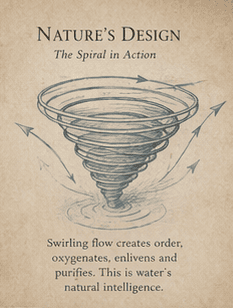
A vortex is one of nature’s recurring forms of movement. We see it in whirlpools, shells, storms, blood flow, rivers negotiating bends, and the spiralling forms found throughout the natural world.
In a vessel, swirling water creates circulation. It mixes minerals, distributes temperature, forms a visible centre of movement and changes the sensory experience of pouring and drinking. Schauberger saw inward spiralling motion as nature’s characteristic movement of concentration, cooling and renewal.
Temperature and protection
Schauberger repeatedly emphasised cool water. Natural springs often emerge at a stable temperature because they have travelled through earth and stone. He also valued protecting water from strong light and heat, reflecting the sheltered conditions of water beneath forest canopies, beneath the soil and within the ground.
For home storage, this suggests simple practices: keep prepared water covered, avoid leaving it in direct sun or beside heat sources, and use materials that do not easily transfer unwanted taste or heat.
Curved forms
Schauberger-inspired egg-shaped vessels continue this preference for organic form. Their continuous curves avoid sharp internal corners and are intended to support gentle internal circulation as temperatures change around the vessel.
The egg is one of nature’s great containers: a form that protects life, contains movement and grows without corners. Used for water, it becomes both a practical vessel and a reminder that the form in which we hold water affects our relationship to it.
Movement, vitality and the body
Water is alive in movement. A river flows, turns, falls, gathers, separates, cools, aerates and returns. The Earth itself is never still: weather circulates, tides rise and fall, magma moves beneath the ground, sap rises through trees and rivers continually reshape their banks.
The human body reflects this same principle. Blood does not stop moving. Breath moves in and out. The heart contracts and releases. Nerve signals travel. Fluids circulate through tissues, organs and cells. Life is not static; it is rhythmic, flowing and dynamic.
The body is electrochemical and continuously moving. Water is the medium in which much of its circulation, signalling and exchange takes place. Schauberger’s question is whether water treated in ways that oppose nature’s own movements can still be regarded as equivalent, in quality and vitality, to water shaped by the living processes of the Earth.
Stagnation is not simply a quality of water left standing. It is a condition that runs contrary to the movement through which nature sustains itself. Schauberger’s work invites us to see the vortex as one of nature’s most efficient and elegant patterns of movement: a form that gathers, circulates, cools and renews without brute force.
The practical lesson is not that every glass of water must come from a wilderness spring. It is that water intended for human life should be treated with an awareness of its natural qualities. It should be clean, mineral-balanced, cool where possible, protected from excessive heat and light, allowed movement and stored in forms that support rather than disregard its character.
Processing Water in Harmony with Nature
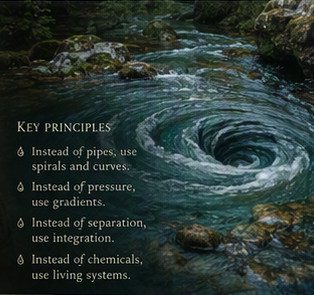 Whenever we process water, we should ask whether the process merely removes what is unwanted, or whether it also takes us further from the qualities of natural water that we value.
Schauberger’s observations suggest an aim: begin with purity where necessary, then restore as much as possible of water’s natural character—its coolness, mineral balance, movement, protection and relationship to living forms.
The best approach depends on the source water in your home.
TDS means total dissolved solids (TDS): the combined amount of minerals, salts and other substances dissolved in water. It gives a general indication of composition, though it does not tell us by itself which substances are present or whether they are desirable.
Whole-house filtration
Whole-house filtration treats water as it enters the home, improving the water used for showers, baths, laundry, washing up and drinking.
A typical system combines a sediment filter for rust, grit, sand and pipe debris; activated-carbon filtration for chlorine, odours and many taste-affecting compounds; and a scale-management stage to reduce limescale deposition in pipes and appliances.
When choosing a system, look for clear information about the filtration media, flow rate, cartridge cost, replacement intervals, independent testing and the specific contaminants tested. Activated carbon is particularly useful for chlorine-related taste and odour, while performance depends on the quality and amount of carbon, the rate of water flow and regular maintenance.
Choose a purification route
For drinking water, reverse osmosis and distillation offer two different routes to a highly purified base. They are alternatives. The better choice depends on the source water, household preferences, budget and desired process.
Reverse osmosis uses pressure to pass water through a fine membrane. It can reduce many dissolved substances while providing filtered water continuously at the tap. Look for independently tested reduction claims, accessible membrane replacement, reasonable water-efficiency figures, and a post-filtration mineral stage if you prefer a more spring-like taste and mineral composition.
Distillation uses evaporation and condensation. Water is heated into steam; many dissolved substances remain behind; then the steam is cooled and collected as water again. Distillation offers a slow, deliberate and visible process that echoes the natural cycle of evaporation, cloud and rain.
For a countertop distiller, look for stainless-steel water-contact surfaces, a glass collection vessel, easy cleaning access, automatic shut-off and a final carbon stage for polishing the collected water.
Restore mineral character
Highly purified water can become the blank canvas from which a more balanced drinking water is built.
Mineralisation restores a more rounded, spring-like character through calcium, magnesium and bicarbonate. These minerals influence taste, composition and electrical conductivity, while also reflecting the mineral journey of water through earth and stone.
A balanced remineralisation concentrate or post-filtration mineral cartridge allows minerals to be introduced deliberately and consistently. Look for transparent ingredients and clear dosing guidance, with calcium, magnesium and bicarbonate forming the core of the profile.
Calcium and magnesium in water can contribute to dietary intake and influence the taste and character of drinking water.
Store, rest and circulate
Once water has been filtered, purified or mineralised, it can be handled with care.
Allow distilled water to cool before storage. Keep it covered and away from direct sunlight or heat. Use glass, stainless steel or food-safe ceramic rather than disposable plastic. Pour gently between glass vessels if you enjoy the effect of aeration. Create a brief vortex before serving if this helps you engage with the water’s movement. Keep vessels, lids and taps clean.
The aim is not to reproduce a mountain spring perfectly. It is to bring more of nature’s principles into ordinary daily life.
Conclusion
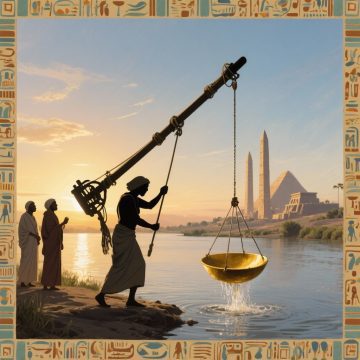
The question raised by the ancient Egyptians remains with us: does the way we handle water shape the way we understand life itself?
In more recent times, Viktor Schauberger gave that question renewed urgency. He asked us to remember that water is not merely a utility, a chemical formula or a commodity in a plastic bottle. It is the moving medium of life: flowing through landscapes, circulating through bodies, carrying minerals, shaping rivers and connecting the Earth’s great cycles.
Living waters are moving waters. To prepare water with care—to purify it where needed, restore its mineral character, keep it cool, allow it circulation, and store it in natural forms—is to recover something that convenience has too often hidden from us.
Products Mentioned
Whole-House Water Filtration
- BMB-1000 Hydra Home Whole-House Water Filtration System Whole-home sediment, activated-carbon and scale-management filtration system for improving water used throughout the house.
Countertop Water Distillers
- Megahome MH943TWS Water Distiller with Glass Collection Stainless-steel countertop steam distiller with glass collection vessel, porcelain-lined nozzle and optional activated-carbon filter.
- VEVOR 4 L Water Distiller with Glass Carafe Stainless-steel countertop distiller with glass carafe, condenser, temperature display, timer and carbon packs.
- AquaNui Countertop Water Distiller Countertop distiller with glass collection jar, volatile-compound venting and a carbon post-filter.
Egg-Shaped Water Storage
- Water Egg™ — Centre for Implosion Research Handmade, internally glazed ceramic egg-shaped vessel with lid, stand and tap, designed for covered water storage.
- Water Egg — Conscious Spaces Egg-shaped water-storage vessel inspired by natural circulation and Schauberger-related water principles.
- Water Egg — TrueSpring Ceramic Water Egg produced in Alsace, Germany and described as using Schauberger-inspired geometry.
Vortexing and Water Movement
- The Schauer — Viktor Schauberger-Inspired Water Vortexer Handmade vortex device designed to create a visible spiral movement in water before serving.
- HEXAGON Water Swirler and Glass Carafe Water-swirling device supplied with a glass carafe for creating a gentle vortex before drinking.
- Schauberger Water Funnels — Etsy UK A collection of handmade vortex funnels and Schauberger-inspired water accessories.
Glass Water Vessels
- Eva Solo Cool Carafe Glass water decanter suitable for cooling, serving and storing prepared drinking water.
- Hand-Blown Glass Carafe with Bamboo Stopper Glass carafe with bamboo stopper for covered storage and serving of prepared drinking water.
References
- Naydler, Jeremy. In the Shadow of the Machine: The Prehistory of the Computer and the Evolution of Consciousness. Temple Lodge Publishing, 2018.View book
- Ramsey, Scott C. The Effects of Living Water on Participants: Connection to Nature. Doctoral dissertation, Prescott College, 2018.Research examining how a multi-day wilderness river experience on the Tatshenshini River affected participants’ connection to nature, awe, “river time” and sustainable orientation.
- Luzar, Alenka, and David Chandler. “Hydrogen-Bond Kinetics in Liquid Water.” Nature, 1996.Foundational research concerning the dynamic nature of hydrogen bonds in liquid water.
- Brezina, Karel, et al. “Hydrogen-Bond Structure Dynamics in Bulk Water: Insights from Ab Initio Simulations.” Chemical Science, 2018.Read article
- Lu, X., and R. Wang. “Hydrogen-Bond Network and Local Structure of Liquid Water: An Atoms-in-Molecules Perspective.” Journal of Physical Chemistry B, 2008.Read abstract
- Nielsen, Johannes K., et al. “Towards a Unified Description of the Hydrogen Bond Network of Liquid Water.” Journal of Chemical Physics, 2014.Read abstract
- World Health Organization. Nutrients in Drinking Water. WHO, 2005.View publication
- World Health Organization. Calcium and Magnesium in Drinking-Water: Public Health Significance. WHO, 2009.View publication
- World Health Organization. Technical Notes on Drinking-Water, Sanitation and Hygiene in Emergencies: Aeration.Read technical note
- University of Nebraska–Lincoln Extension. Drinking Water Treatment: Activated Carbon Filtration.Read guide
- University of Massachusetts Amherst Extension. Activated Carbon Treatment for Drinking Water Supplies.Read guide