The Sacred Art of Offering
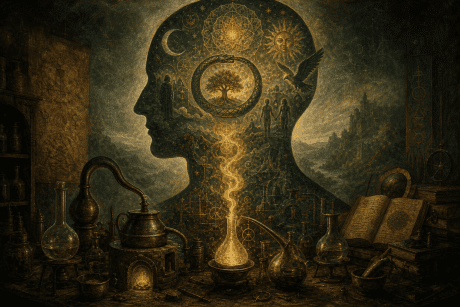 Ritual and offering are inseparable. Across cultures, throughout history, and even now, one principle appears again and again: to receive, one must first give. This is not merely symbolic, but reflects a deeper pattern in how people understand transformation itself.
The Hermetic tradition expresses this through the principle of cause and effect: every cause has its effect, and every effect its cause. In ritual terms, intention alone is not enough; it must be joined to an act—an offering—that sets the desired outcome into motion. Energy must be directed, attention must be focused, and something of value must enter the exchange.
It’s a sacrifice
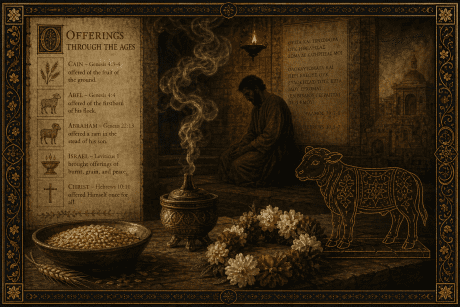
Offerings take many forms. Some are simple and personal: fasting, surrendering comfort, or giving up a habit. Others involve material gifts—food, incense, coins, flowers, or objects of personal value. In more extreme expressions, history also records the sacrifice of animals and even human beings, revealing how deeply rooted the belief has been that real change demands real cost.
At its core, offering is inseparable from sacrifice. To sacrifice is not simply to lose something, but to make it sacred—to lift it out of ordinary life and charge it with intention, meaning, and spiritual purpose. What is given up becomes part of a larger act of transformation.
From Offerings to Alchemy
 This is where the idea meets alchemy. In alchemical thought, transformation is the central process: a movement from one state into another, from the crude to the refined. Yet nothing is transformed without first being broken down, dissolved, or purified. The old form must yield before the new can emerge.
Carl Jung saw alchemy as far more than an early attempt at chemistry. He argued that alchemical symbols reflect inner psychic processes, and that the work of transformation in alchemy mirrors the process of individuation—the gradual integration of the self through contact with the unconscious. In that sense, ritual offering is not just an outer act but an inner one, speaking directly to the subconscious through symbol, gesture, and sacrifice.
From Alchemy to Chemistry
This same pattern appears in science as well. In chemistry, energy is required to break bonds, while energy is released when new bonds form; transformation is never without exchange. Physics and chemistry do not describe ritual, but they do confirm a broader truth: change is not free, and every new state requires an input, a release, or a reordering of energy.
Alter on the Altar
 In many rituals, objects are placed at the centre—on an altar, in a circle, or within a sacred space. These objects are not merely decorative. They serve as focal points, representing what is being offered, what is being surrendered, or what is being transformed. They give material form to an invisible intention, allowing the inner act to become visible and tangible.
The Christian altar offers a striking parallel. The word altar does not literally mean “to alter”; its root lies in the Latin altare, the place of sacrifice and offering. Yet the echo is still poetically fitting, because the altar is indeed a place of alteration—a place where transformation is enacted. In Christian worship it becomes the point where offering, sacrifice, and sacred change meet, and in many churches light is used deliberately to intensify that sense of divine presence and holiness.
Sacred places

There is also a reason sacred offerings were so often brought to stone temples, shrines, springs, and high places. Such sites were often understood as points of contact between worlds—places where heaven, earth, ancestors, and gods drew closer together. In later spiritual interpretations, some have linked these places to ley lines, imagined as subtle pathways of terrestrial energy, like an organic web across the land through which intention could be carried or amplified.
Making your Ritual
 A simple offering ritual today can still follow the old pattern. Begin with a clear intention: what are you asking for, releasing, or seeking to transform? Then choose a real offering—perhaps time given daily to a discipline, the surrender of a limiting habit, or a deliberate act of restraint. This can be reinforced by placing an object in a dedicated space as a symbol of that commitment, turning the object into a visible anchor for an invisible exchange.
The power is in the sacrifice
The power of the act lies in sincerity. An offering only becomes meaningful when it carries real weight for the person making it. That is why the art of offering is not about theatrical display, but about conscious exchange: to ask for change while also consenting to cost, discipline, and transformation. To invite the new, something must be given up.
-
Adoremus. “What Is an Altar (Part II)? The History of the Christian Altar.” Adoremus Bulletin, 29 September 2022.
-
Aureum Architects. “The Divine Connection Between Natural Light and Sacred Architecture.” Aureum Architects Blog, 29 January 2025.
-
BBC Bitesize. “Bond Energy Calculations – Energy Changes in Chemical Reactions.” BBC Bitesize – GCSE Chemistry, 9 February 2023.
-
Behrend, Michael. “Straight Lines on an Ancient Landscape.” (Discussion of Alfred Watkins and early ley line ideas.)
-
Britannica. “Ley Lines.” Encyclopedia Britannica, 7 January 2025.
-
Countryfile. “Ley Lines: Are Britain’s Ancient Sites Linked by Secret Pathways Across the Landscape?” BBC Countryfile, 4 June 2024.
-
Etymonline. “Altar – Etymology, Origin & Meaning.” Online Etymology Dictionary.
-
International Association for Analytical Psychology. “Alchemy.” IAAP – Short Articles on Analytical Psychology, 14 December 2025.
-
Jung, C. G. Psychology and Alchemy. Collected Works, Vol. 12. (Original German ed. 1944.)
-
Jung, C. G. Alchemical Studies. Collected Works, Vol. 13.
-
Sacred Texts Archive. “The Kybalion: Chapter XII – Causation.”
-
Wikipedia. “Psychology and Alchemy.” Wikipedia.
-
Wikipedia. “The Kybalion.” Wikipedia.
-
WTAMU – Charles Baird. “When Does the Breaking of Chemical Bonds Release Energy?” Science Questions with Surprising Answers, 26 June 2013.
-
Chemistry LibreTexts. “Bond Energies.” Chemistry LibreTexts.
-
Fiveable. “Bond Enthalpies – AP Chemistry 6.7.” Fiveable Study Guide, 8 June 2026.
-
Atlas Obscura. “Ley Lines and the Allure of Imposing Order on History’s Chaos.” Atlas Obscura, 12 February 2025.