Compton Dundon & Yew Tree
Compton Dundon is a quiet Somerset village nestled between the Polden Hills and the Somerset Levels, a little south of Glastonbury. Old lanes, stone cottages and the small parish church of St Andrew sit in a shallow fold of land, with the ground suddenly rising behind into Dundon Hill and Lollover Hill, giving a sense of the village being cradled between high ground and wetland. Above, the ridge of Dundon Hill carries traces of an Iron Age hillfort and later beacon site, once part of a chain of lookouts across the Levels, so you have prehistoric defence, medieval watch-point and modern countryside all layered into one tight landscape.
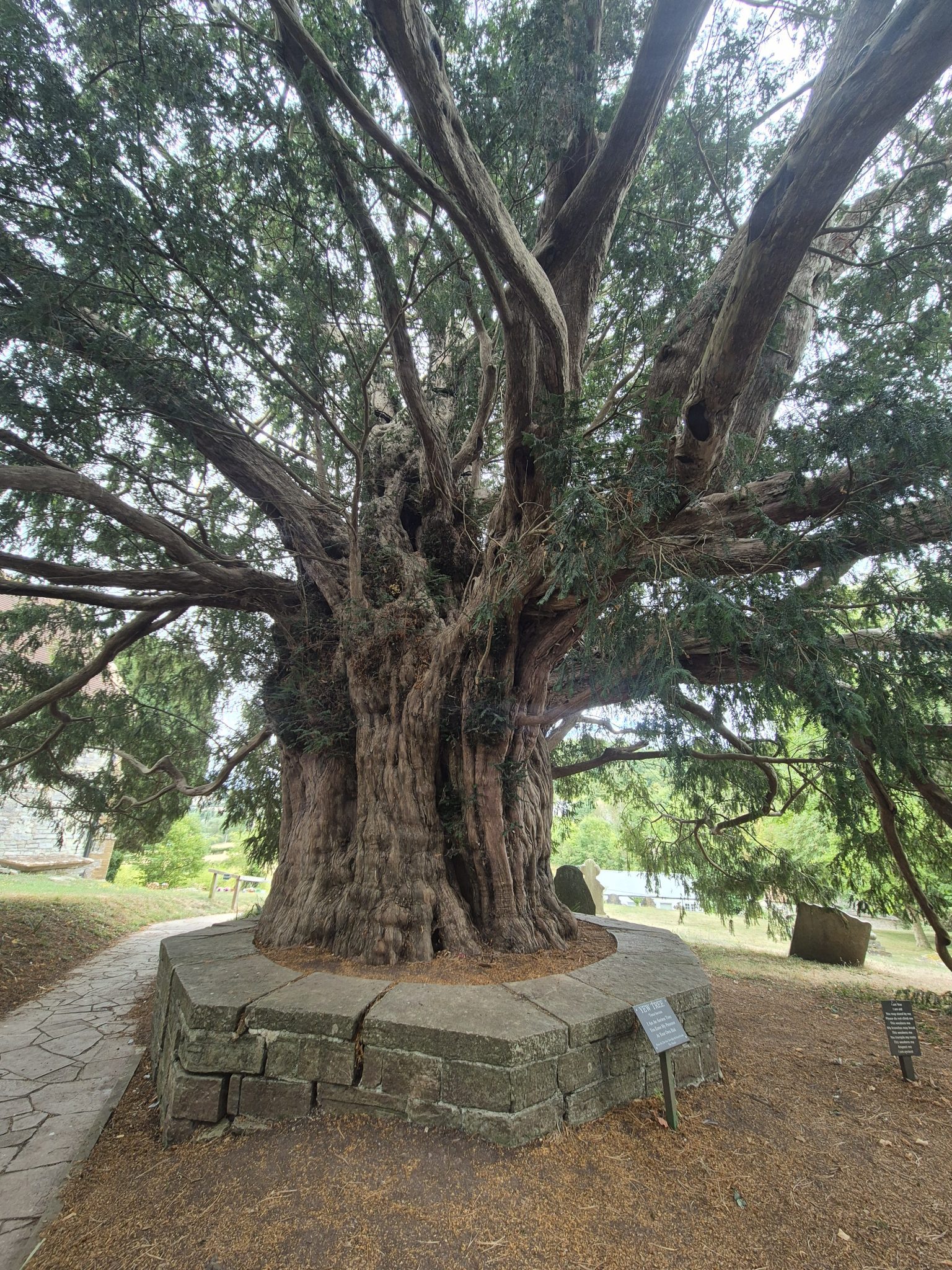
At the heart of it all stands one of the most remarkable features of the area: the ancient yew tree in St Andrew’s churchyard. This yew is often estimated at well over a thousand years old (some suggest closer to 1,500–2,000), meaning it was likely already a sacred tree long before the current medieval church was built around it. Its massive, hollowed trunk and wide, sheltering branches give the sense of a living ancestor in the middle of the graveyard, a survivor from an older ritual landscape that the later Christian site has wrapped itself around. For many visitors, the yew is the true focal point here — a place to stand quietly, rest a hand on the bark, and feel the depth of time and memory rooted in this small, unassuming village.
From the A39/Street area, take the B3151 south towards Somerton. Turn into School Lane in Compton Dundon
-
A tree older than the churchThe great yew in St Andrew’s churchyard is assessed at over 1,700 years old, meaning it was already ancient when the current 14th–15th‑century stone church was built around it. Earlier surveys recorded its hollow trunk at about 23 feet (7 m) in circumference, with space once large enough for several children to hide inside./
-
A hollow giant slowly closing itselfIn the 18th and 19th centuries, writers described the tree as a vast, hollow “shell” with a high crown; in the mid‑20th century the local rector noted you could still climb inside, but warned parents their children might get stuck as the gap was closing. Recent measurements show the opening has narrowed dramatically, so from the outside the yew is slowly becoming solid again, sealing its own inner chamber after centuries.
-
A triple-yew churchyardSt Andrew’s doesn’t just have one notable yew; at least three significant yews have been recorded in the churchyard. Alongside the great ancient tree on the south side, there is a fine male yew by the western wall and a large clipped female yew to the north, giving the site a kind of yew “family” encircling the church.
-
Saxon site wrapped into a later parishThe settlement at Compton Dundon was inhabited in Saxon times, and the church is first mentioned in 1291, when it passed to Wells Cathedral. The presence of such an old yew on this spot supports the idea that the churchyard area was a pre‑Christian meeting or ritual place that the later medieval church absorbed into its own sacred landscape.
-
Hillfort, beacon and “natural fortress” aboveJust above the village, Dundon Hill Hillfort encloses about 5 hectares with a single rampart following the hilltop, overlooking a bend in the River Cary and the Somerset Levels. In its south‑east corner sits Dundon Beacon, originally a Bronze Age barrow later re‑worked as a Norman motte, so within a short walk you move from an Iron Age defended hill, through medieval beacon and motte, down to a Saxon‑era worship site and a yew that may have been sacred long before any of them.