Burrow Mump
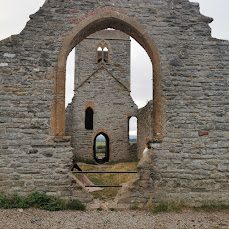
Burrow Mump is a steep “island hill” of 250‑million‑year‑old Triassic sandstone rising from the Somerset Levels, crowned by the roofless 18th‑century St Michael’s Church, which stands on the site of a 15th‑century church and earlier 12th‑century masonry with roots going back at least to Roman occupation and Alfred’s watch for Viking raiders.
Its flanks are ringed with medieval terraces cut to create workable ground on a hill that often became isolated by floodwater, and its taut name — “Burrow Mump,” literally “Hill Hill” — underlines how it dominates the flat landscape.
Like Glastonbury Tor, it is also woven into modern lore as a meeting point of the Michael and Mary lines, a small but potent vantage where you can simply enjoy the wide river views or take time to connect with the subtler energies of the land.
Location: Situated on the A361, between Taunton and Glastonbury.
Parking: A free National Trust car park is available at the base of the hill, just off the main road.
Access: It is a steep but short walk to the top of the mound to view the ruined church.
-
Natural hill turned Norman fortressThe top of Burrow Mump is a natural sandstone mound that was later shaped into a Norman motte, with a scarped summit and a spiralling track up the side. Excavations show a 12th‑century masonry building up here, probably part of an “adulterine” (unauthorised) castle thrown up during the civil war known as The Anarchy in the 1130s–1150s
-
“King Alfred’s Fort” – legend and likelihoodLocals have long called it King Alfred’s Fort, and later writers say Alfred used the hill to watch for Viking ships moving along the rivers. Archaeologists point out there’s no hard evidence he actually did so, but the hill’s clear line of sight to Athelney — Alfred’s known stronghold — makes the story geographically plausible, which is why the legend has stuck.
-
Battlefield sanctuary on a little hillBattlefield sanctuary on a little hill The medieval St Michael church on the summit belonged to nearby Athelney Abbey and became a makeshift strongpoint in multiple wars. Royalist troops holed up here during the English Civil War in 1642 and again in 1645, and it was also occupied in 1685 during the Monmouth Rebellion, turning this small church on a hill into a temporary battlefield redoubt.
-
The church that was never finishedThe ruined St Michael’s you see now is an 18th‑century rebuild begun in 1793, designed with a west tower, three‑bay nave and south porch in lias stone with red‑brick dressings. Funds ran out even after donations from figures like William Pitt the Younger and Admiral Hood, so the project stalled, a new parish church was built down in Burrowbridge in the 1830s, and the hilltop church was left to decay.
-
War memorial in the skyIn 1946, landowner Major Alexander Gould Barrett gifted the Mump and its ruined church to the National Trust as a county war memorial. The site now formally commemorates over 11,000 Somerset men who died in the First and Second World Wars, so when you stand in the roofless nave you’re in a place that holds Saxon legend, Norman fort, village church and modern memorial all in one small, windswept summit.