St Mary Woolnoth
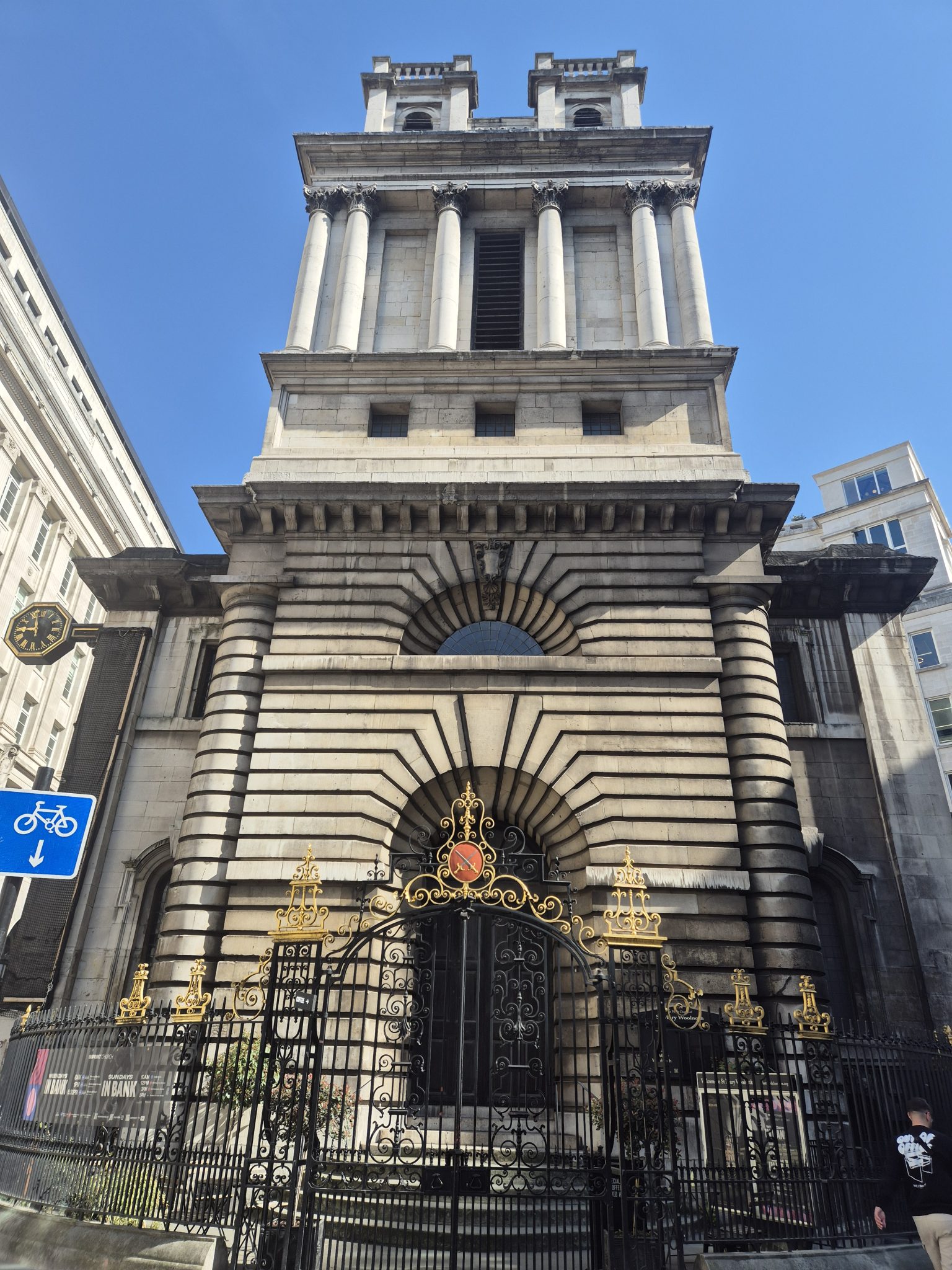
St Mary Woolnoth is a striking Baroque church on the corner of Lombard Street and King William Street, a stone’s throw from Bank Junction in the heart of the City of London. Designed by Nicholas Hawksmoor and completed in the early 18th century, it is known for its bold, almost fortress‑like façade and distinctive twin‑towered west front. The interior is relatively compact but richly modelled, with galleries, large round‑headed windows and an elegant classical layout that contrasts with the busy streets outside. Parts of the crypt and substructure were reworked in the 20th century to accommodate Bank underground station below, making the church a rare example of a historic building literally sharing foundations with modern transport infrastructure. Today St Mary Woolnoth remains a Grade I‑listed church and a quiet spiritual presence amid the surrounding banks and offices.
-
Unusual name and Saxon rootsThe “Woolnoth” in St Mary Woolnoth most likely comes from Wulfnoth (or Wulnoth) de Walebrok, a Saxon noble or landholder associated with the church site in the 12th century. A less‑supported alternative links the name to the medieval wool trade, by analogy with the nearby lost church of St Mary Woolchurch Haw.
-
Hawksmoor’s bold Baroque designThe present church was designed by Nicholas Hawksmoor and built between 1716 and 1727, replacing an earlier, partly Wren‑repaired structure. Its heavy, block‑like west front and twin tower‑turrets are very distinctive in the City, often noted for their almost fortress‑like, slightly austere Baroque character.
-
Church sharing space with the UndergroundWhen Bank Underground station was expanded in the early 20th century, engineers cut through the crypt to create passageways and lift shafts, underpinning the church to keep it standing. As a result, St Mary Woolnoth is one of the few churches whose substructure is physically integrated with a major Tube interchange below.
-
Links to “Amazing Grace” and T.S. EliotFrom 1780 to 1807 the rector here was John Newton, a former slave‑ship captain turned Anglican priest, best known as the author of the hymn “Amazing Grace”. The church later appeared in T.S. Eliot’s poem “The Waste Land”, where the line “St Mary Woolnoth kept the hours / With a dead sound on the final stroke of nine” evokes its bells tolling over the City.