When Money Ignores Nature
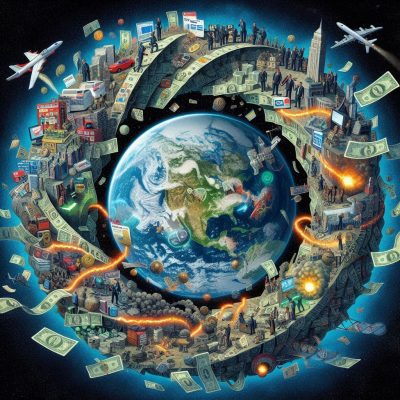
Quantitative easing and modern fiat finance have created an economic ecosystem that no longer behaves like a living organism rooted in limits, but like a machine that can run past those limits for a dangerously long time. Wars, corporations, and grand elite projects can now be funded almost indefinitely, with the true costs pushed onto the future rather than checked by the discipline of the past.
From gold limits to infinite credit
Under the gold standard, war and state ambition were ultimately constrained by something physical: if a government ran out of gold or the ability to credibly promise redemption, it ran out of money. Armies marched only as far as treasuries and taxpayers could actually bear, and prolonged conflict risked currency crises and domestic revolt rather than being smoothed over with new layers of debt.
Today’s fiat system severs that link. As long as there is political will and central bank support, states can extend and roll over debt, issue new bonds, and have those bonds bought with freshly created money. War becomes a line item in an ever-expanding balance sheet rather than a hard test of national solvency. What would once have been economically impossible can now be made temporarily affordable, at the cost of loading yet more claims onto the future.
Perpetual startups and subsidised giants
The same logic applies to business. In a world of cheap credit and investor liquidity, companies can operate at a loss for years or decades, sustained by repeated funding rounds and bond issues until they finally achieve dominance. A firm like Amazon could tolerate long stretches of unprofitability while it built infrastructure, crushed competition, and redefined entire sectors, because capital markets were willing to absorb the losses in anticipation of future monopoly‑like gains.
On the surface, this looks like patient, visionary investment. Underneath, it is again the present financed by claims on the future: today’s low prices, convenience, and disruption are paid for by tomorrow’s market power, data extraction, and the eventual need to justify all that sunk capital. The system encourages scale, speed, and risk‑taking, but not necessarily wisdom, because downside can be socialised or postponed while upside is privatised now.
Stealing from tomorrow without learning from yesterday
The common thread is temporal: an economic order that continually drags resources forward from the future without integrating the wisdom, restraint, or ethical frameworks inherited from the past. Governments, corporations, and financial elites launch projects and policies whose true costs will be borne by people who had no say in them. Those future citizens inherit not only the debt but also a material world shaped by today’s short‑term incentives: exhausted ecosystems, fragile supply chains, and social fabrics thinned by inequality.
Elites choose what to build, bomb, or subsidise; everyone else is presented with the bill. Present generations pay through taxes, higher living costs, and erosion of public goods, while future generations are bound to honour debts and adapt to a planet, and an economy, moulded by decisions they never consented to. It is not just intergenerational debt; it is intergenerational design imposed from above.
Sound money as a moral brake
This is why “sound money” is not only a technical slogan but a moral demand. A monetary system that is credibly constrained—by convertibility, hard limits on issuance, or strict rules that cannot be bent for convenience—forces society to confront trade‑offs in real time. Wars must be weighed against what citizens will immediately lose. Mega‑projects must be justified to people who actually fund them. Bad investments are punished by real losses, not quietly papered over by new credit.
In such a system, spending beyond natural, social, or ecological limits hurts quickly enough to change behaviour. If the public does not value genetically modified foods, surveillance gadgets, or speculative real estate, capital tied up in those ventures is genuinely at risk. Investors learn, not because a regulator publishes a report, but because reality marks their balance sheets to truth.
Rewarding the truly useful
On the other side, constrained money is also an ally of the genuinely industrious. Entrepreneurs who create products and services that people both want and need—tools that save time, heal, educate, or restore—are rewarded with real profits, not just rising valuations in a liquidity bubble. Their success is anchored in voluntary exchange, not in proximity to the money spigot.
In that world, marketing would return to its best possible meaning: the craft of honestly communicating why something is valuable, helping good ideas find their audience. It would be less about manipulating attention for a quick exit and more about building long‑term trust. The discipline of sound money would not eliminate greed or folly, but it would make them harder to hide and quicker to correct.
An unnatural economic system lets weak, unwise decisions compound for decades by insulating them from consequence. A more natural one restores feedback: it lets reality say “no” in time to matter—and ensures that when we build the future, we are not simply strip‑mining it.
Here they are, one per line and separated:
-
https://etonomics.com/2025/05/22/gold-standard-vs-fiat-money/
-
https://www.investopedia.com/ask/answers/09/gold-standard.asp
-
https://blogs.cfainstitute.org/investor/2013/04/16/gold-and-international-reserve-currencies/
-
https://www.goldsilverbuffalo.com/the-gold-standard-vs-fiat-currency-history-and-plausibility/
-
https://www.goldmoney.com/research/currency-wars-versus-gold-standards
-
https://www.nber.org/system/files/working_papers/w10171/w10171.pdf